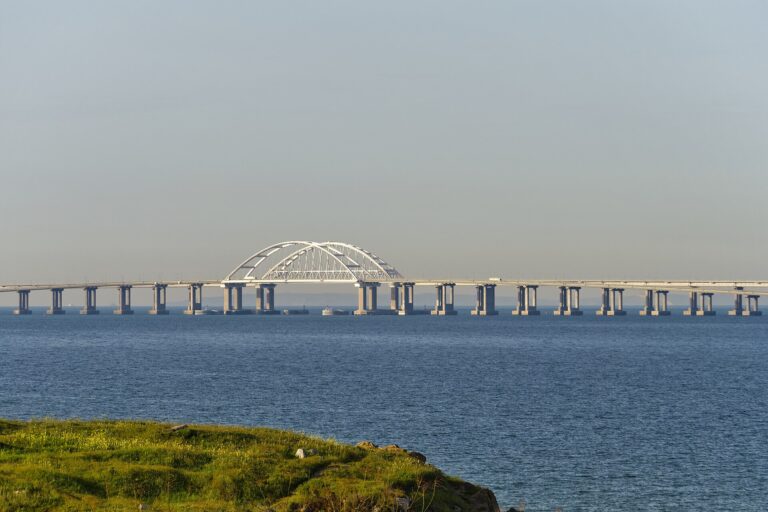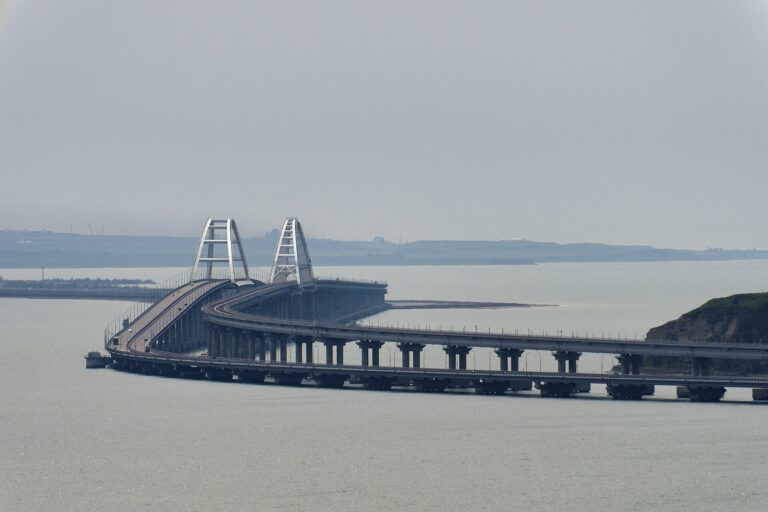
According to the specialists involved, Ukraine deployed dozens of relay drones during the operation against the Crimea Bridge to maintain the connection to its attack drones and missiles despite Russian jamming attempts. The “Kyiv Post” reports this, citing a conversation between the experts of the 7th Separate Centre of the Unmanned Systems Forces and the “Financial Times”. The drones, described as “flying modems”, maintained live video connections to the weapons so that the operators could guide them through the dense Russian air defence and electronic warfare, as the “Kyiv Post” reported on Thursday.
If individual relay drones were shot down or jammed, others took over their task. According to the specialists, the Ukrainian weapons were thus able to advance significantly further into Russian-controlled territory and nevertheless remained connected to their operators. The system also improved targeting accuracy, the report says.
A soldier cites 161 kilometres per hour as the limit
A Ukrainian soldier told the “Financial Times” that access to the military satellite internet Starshield had been limited to a connection speed of 161 kilometres per hour for more than a week. The operation required a much higher transmission rate, which is why they did not rely on the satellite system. The “Kyiv Post” reproduces the figure in this form.
Already on Tuesday, “Ukrainska Pravda”, citing the “Times”, had reported that a Ukrainian officer involved in the planning, who was not named, had stated that Ukraine no longer needed Starlink and Starshield networks for attack missions. “For the first time in history, we used all these drones to transmit video signals to the missiles so that they could hit specific points of the bridge,” he said, according to “Ukrainska Pravda”. “We have shown that we can carry out such operations without Starlink.”
President Volodymyr Zelensky’s technology adviser, Serhii Beskrestnov, had hinted at the communications trick shortly after the attack. On Facebook, according to the “Kyiv Post”, he wrote that it was a “strange coincidence” that access to Starshield had been restricted shortly before the operation. Russian experts were now puzzling over how Ukraine had been able to maintain a stable connection in the Krym region, where Russian forces were blocking communications with powerful technology.
Russia deployed relay drones first
The technology has an ironic backstory: according to Beskrestnov, Russia was the first to deploy relay drones, and Ukraine adopted them in 2023. Most of these drones were later equipped with modems that China had supplied to Russia. Only this summer had Ukraine learned to block their signals, said Beskrestnov.
According to the “Kyiv Post”, the operation itself ran in two waves on the nights of 16 and 17 November. The attacks brought down the 227-metre-long arch of the road section of the bridge. The adjacent railway arch remained standing, and rail traffic resumed after a temporary interruption. Footage from a camera on a Ukrainian Flamingo missile approaching the middle section of the bridge spread quickly online after the attack.
On the night of Thursday, according to “BBC News Ukrainian”, Ukraine attacked the bridge again. The Moscow-installed head of the Krym administration, Serhii Aksyonov, reported the attack around midnight. Traffic was temporarily closed, all relevant services were deployed, and the damage was being assessed, “BBC News Ukrainian” quoted him as saying. According to the report, rail traffic came to a standstill. The Telegram channel “Krymskij Veter” reported that the arch of the railway section had not collapsed and that no major damage was visible. The General Staff of the Ukrainian Armed Forces did not comment directly on the new strike but congratulated the Vasco da Gama Bridge in Lisbon on Telegram for its title as Europe’s longest bridge structure – a hint that “BBC News Ukrainian” interprets as an allusion to the complete destruction of the Kerch Bridge.
President Zelensky had justified the attacks in an interview with NBC News as a response to Russian attacks on Ukrainian infrastructure. “This year, their goal was to destroy our infrastructure: railways and bridges. They attacked them often. Of course, we had to respond. And of course, we responded to the Crimea Bridge,” he said, according to “BBC News Ukrainian”.
The bridge is central to the supply of Russian troops in the south. The “Süddeutsche Zeitung” reports that Russia, for its part, attacked targets throughout Ukraine and damaged two central bridges over the Dnipro in Kyiv. Another prisoner exchange was the only tangible result of the negotiations between Moscow, Kyiv and Washington; now the Americans were travelling to Putin.
Earlier coverage: Crimea bridge hit without Starlink, Ukraine officer says