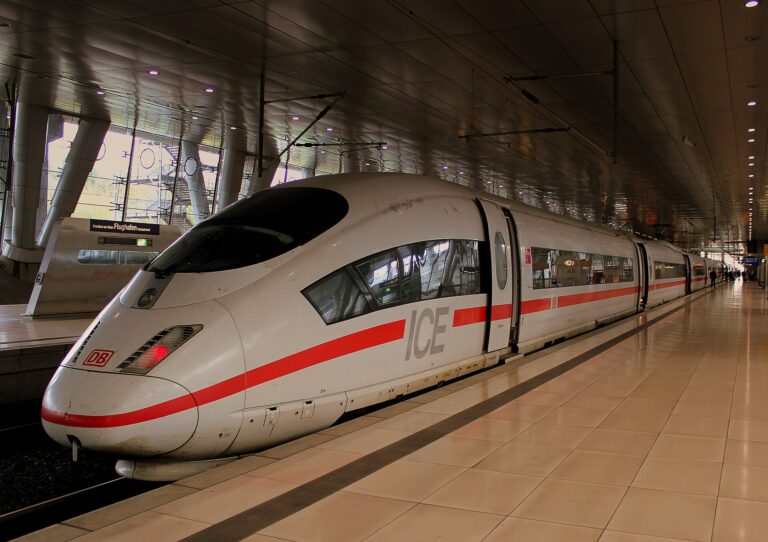
Germany’s new rail timetable takes effect on Sunday, 13 December 2026. According to Deutsche Bahn, long-distance fares stay stable, and tickets for the new timetable have been on sale since 14 October at bahn.de, in the DB Navigator app, at travel centres and through agencies. “In times of expensive fuel, the train remains a good and affordable alternative to the car and the plane,” said DB board member Michael Peterson, who is responsible for long-distance passenger services.
For travellers from Munich and Bavaria the changes are significant, and not all of them are welcome. The essentials.
What gets faster from Munich?
- Hamburg–Munich: express “Sprinter” trains three times a day in each direction, stopping only in Hanover and Nuremberg. The journey takes 5 hours 20 minutes, about 20 minutes less than before.
- Stuttgart–Nuremberg–Berlin: four additional ICE Sprinters. From Nuremberg it takes just under 2 hours to Stuttgart and about 2¾ hours to Berlin. On Berlin–Stuttgart, Sprinters will run three times a day in each direction instead of once.
- Vienna and Linz: after the renovation of the Nuremberg–Passau corridor, fast direct services return from 19 December. An extra evening ICE runs Sunday to Friday as far as Vienna, arriving at 1.03 am.
- Paris: an additional weekend TGV runs direct from Munich and Augsburg. The first daily TGV becomes about 30 minutes faster because it uses the Wendlingen–Ulm high-speed line.
- North Rhine-Westphalia: an ICE leaving Munich at 1.55 pm runs without a change to Paderborn, Hamm, Dortmund and Cologne.
- Italy: from summer 2027, Frecciarossa trains are due to run from Munich via Innsbruck to Milan and Rome, initially one pair of trains a day to each city. DB gives an example departure from Munich at 2.32 pm arriving in Rome at 11.10 pm. The trains still need regulatory approval.
Where it will get bumpy
Major renovation work is running alongside the new services. Between Munich and Salzburg, from 8 February to 9 July 2027 only three pairs of EC trains a day will run, via Mühldorf; the Railjets on Munich–Vienna–Budapest divert via Passau, and Munich–Graz runs via Wörgl. Between Augsburg and Berlin the service drops to seven trips a day in each direction from 5 February. On Frankfurt–Nuremberg, eight ICE trips a day are cancelled from 13 August, though at least one ICE an hour remains. Because of the Hanover–Berlin renovation, direct trains between North Rhine-Westphalia and Berlin take about 80 minutes longer.
For scale: DB cites more than 320 international trips a day, roughly 20 per cent more than five years ago, and over 200 cities in 14 countries reachable directly from Germany. About 70 Sprinter trips a day are planned nationwide. In other words, supply is growing mainly on the main trunk routes, while the price is paid in works on diversion lines and border sections.
Our assessment: anyone planning an Easter or Whitsun trip to Austria should factor in the Salzburg closure from the start. Journey times and diversions during works can still shift, so check the DB Navigator shortly before departure. Whether the Italian service really starts in summer depends on approval; it is only reliable once tickets are on sale.
For families, the DB Family Ticket remains the price anchor: €99.99 for up to five people in long-distance travel, second class, return, seat reservation included; the first travel day was 1 November. Monthly and school monthly passes for long-distance trains without a subscription have been 25 per cent cheaper since 21 October. On local transport, see also our report on the Munich S-Bahn closures until 7 December.
Sources: Deutsche Bahn (Presse), Deutsche Bahn Bayern, ZDFheute