The first-ever three-way meeting of Donald Trump, Xi Jinping and Vladimir Putin ended in Shenzhen on Thursday after about an hour and a half. Wire services reported no agreement by midday (as of 19 November, 11:00 CET). What remains is a set of statements, some pictures – and the question of who will now have a say on Ukraine.
The leaders met in a villa on the sidelines of the APEC summit; Chinese state media said Xi chaired. Trump said they were “truly making history”. Putin spoke of “numerous shared interests” in resolving regional conflicts, “including, obviously, the conflict in Ukraine”, according to UNN. Xi warned that when great powers clash, the world falls into chaos; he did not mention Ukraine, the report says. According to Handelsblatt, he also said nuclear weapons should be banned and completely destroyed, and cautioned Trump on Taiwan.
Who put Ukraine on the agenda
Officially, Ukraine was not on the programme. The White House had said the focus was nuclear arms control, that the Ukraine track runs separately and that China is “not really a part of” it, a senior US official told CBS News. The backdrop: the New START treaty expired in February 2026 and has no successor.
Ukraine was discussed anyway. Putin raised it himself. Earlier, Trump told Xi in their bilateral meeting that the two sides wanted to “help” with the war and “I’d like to see it ended” (Ukrinform, citing Al Jazeera). Kremlin spokesman Dmitry Peskov had said beforehand that Moscow had “no extraordinary expectations”, while Putin aide Yuri Ushakov said talks with Trump on a settlement would continue (TASS). Ukraine’s foreign minister, Andrii Sybiha, had warned the summit would only encourage Putin to keep fighting (Kyiv Independent).
Our assessment: this was more symbolism than substance. Political scientist Jack Goldstone told ZDFheute that Trump could end up a bystander and that China gains little from an end to the war. So far that fits: Putin got a stage, Xi kept his distance, Trump got the images. Whether anything was agreed behind closed doors should become clear within days; it cannot be judged responsibly today.
Berlin as the counter-programme
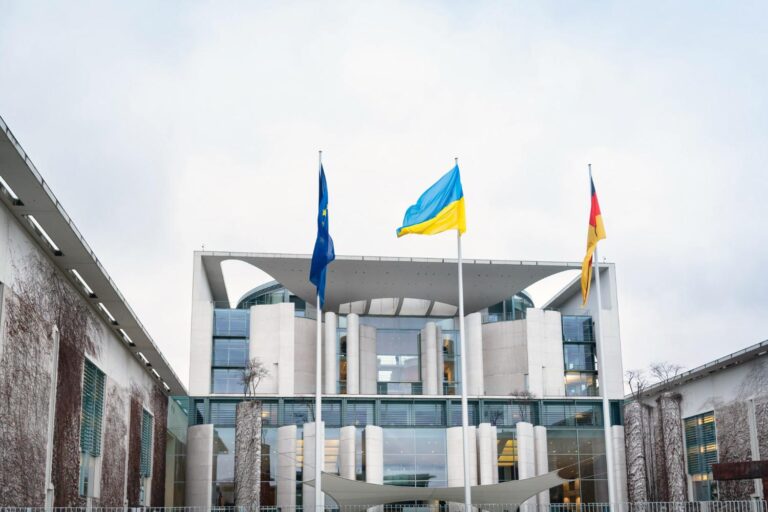
At the same time, Chancellor Friedrich Merz hosted the “Coalition of the Willing” in Berlin. According to the German government, leaders from 37 countries attended, along with EU chiefs and NATO Secretary General Mark Rutte. The agenda covers winter aid and air defence, and legally binding security guarantees for the period after a ceasefire, including a “Multinational Force Ukraine”, closely coordinated with the US. US envoys Steve Witkoff and Jared Kushner are meeting Europeans and Ukrainians in Berlin before a next round of talks with Russia that has not yet been scheduled (RTÉ).
For Europe, the real question is whether it gets a seat at the negotiating table. The EU agreed the structure of its own negotiating team in Dublin; Moscow is sending mixed signals, according to RTÉ, and Peskov questioned whether European involvement would help. Then there is money: the Commission has proposed €45bn for 2027, but four member states are staying out.
Three scenarios look plausible to us. First, the US-led track via Witkoff and Kushner simply continues and Shenzhen becomes a footnote. Second, Beijing tries to cast itself rhetorically as a mediator without taking on commitments. Third, Berlin uses security guarantees and money to force a European seat at the table. Which one materialises depends mainly on whether Moscow accepts a European delegation. This is the editorial team’s assessment, not a certainty.
Earlier coverage: Shenzhen summit: Trump, Xi and Putin – and Ukraine on the sidelines? and Merz hosts Coalition of the Willing summit in Berlin.
Sources: Bundesregierung, UNN, CBS News, TASS, ZDFheute