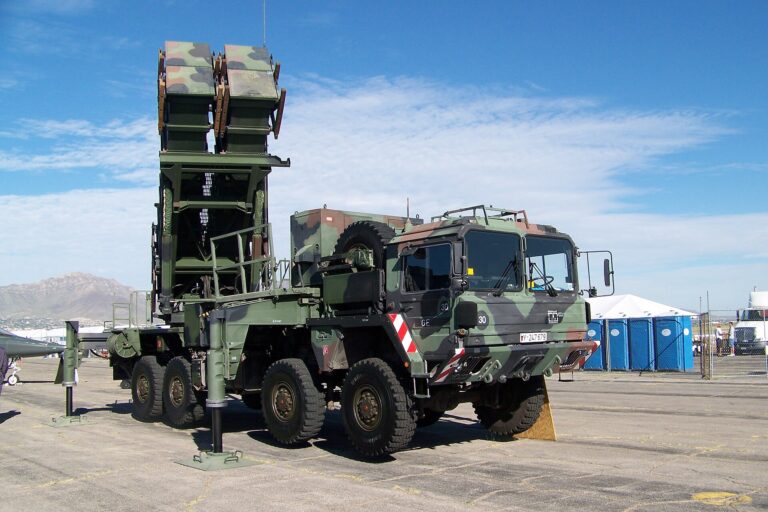
In a Bloomberg interview published on 18 October, Volodymyr Zelensky accused Washington of holding back Patriot interceptors that allies have already paid for on Ukraine’s behalf. “The American side approved the delivery of only some of them, but not the rest. And this is not a technical issue,” he said. The US government has neither confirmed nor explained the figures.
The programme in question is NATO’s PURL, the Prioritised Ukraine Requirements List, through which allies fund US-made weapons for Ukraine. According to NATO, roughly $1 billion a month has flowed in since August 2025, with more than $4 billion pledged by December 2025. Germany is part of it: it co-funded two of the three most recent $500 million packages, alongside Norway, Poland and the Netherlands. What is stuck in Washington is partly European money.
Twelve missiles a month
By Zelensky’s account, the US now supplies just 12 Patriot interceptors a month, about a quarter of the rate under Joe Biden. Kyiv Independent and Ukrinform report that Ukrainian stocks were critically low by mid-October; the Washington Post quotes a Ukrainian official saying only “a handful” remained. Russia fired ballistic missiles at Kyiv on 18 and 19 October, a threat only Patriot batteries reliably counter. On 19 October, according to Ukrinform, a 21-year-old woman was killed and eight people were injured.
A caveat: Zelensky is a party to this dispute. The figure of 12 is his, and there is no independent confirmation. The context, however, is not in doubt: the think tank FDD estimates Russia builds more than 100 ballistic missiles a month, while Ukrainian production of Patriot missiles would take years even with an immediate licence.
The second half of the interview ties in. Zelensky described his “latest model”: “We don’t target Russian diesel, you give us missiles for Patriot systems to protect our facilities.” But Washington, he said, simply wants Ukraine to stop hitting diesel infrastructure altogether, and “if we strike that, they will disconnect us from something.” He spoke of steps taken “to convince Ukraine to capitulate”, citing slowed Starlink speeds, as relayed by Ukrinform.
Why diesel?
The answer lies in Donald Trump’s calendar. On 13 September he publicly demanded an end to strikes on Russian diesel production. On 9 October, after a call with Vladimir Putin, he announced a deal: more than 300,000 tonnes of Russian diesel immediately, up to three million later, with the US Treasury licensing the trade until 7 April 2027. On 10 October Trump said Ukraine needed “a new president”. On 18 October he wrote on Truth Social that Zelensky “doesn’t care” and probably never wanted to end the war, while claiming “great progress” towards peace. US midterms fall on 3 November, and fuel prices are a headache for the White House. Zelensky himself links the “dangerous days” before the vote to this pressure.
In our assessment, three paths are plausible. The likeliest, with real uncertainty, is that the US releases part of the missiles and keeps tying the rest to restraint on refinery strikes. Europe could also fill the gap with its own systems and stocks, though that takes months. The worst case is Kyiv having to choose, before winter, between shielding its energy grid and hitting back. Zelensky says Russia has violated Trump’s energy ceasefire 76 times.
For Germany, the question is uncomfortable: anyone paying into a US supply scheme depends on Washington actually delivering. Berlin has said it will keep sanctions in place and keep supporting Ukraine. Whether that is enough for new Patriot missiles will become clear in the coming weeks.
Sources: NATO, Kyiv Independent, Kyiv Post, Ukrinform, FDD