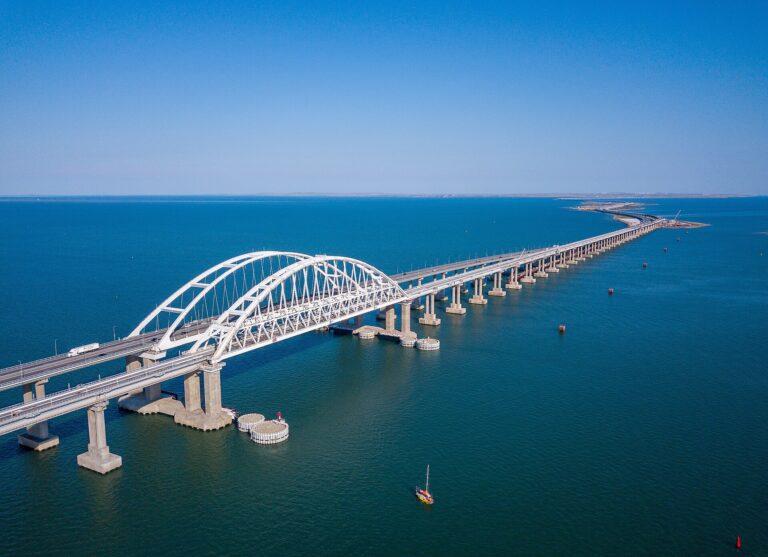
Ukrainian President Volodymyr Zelensky has announced further attacks on the Crimean Bridge and warned Russian President Vladimir Putin that the link across the Kerch Strait would “in any case not stand”. Zelensky said this in an interview with the US television channel NBC News, according to the news outlet zn.ua. On 21 November, the outlet Kyiv Post took up the remarks.
“We will respond to his attacks on our bridges, and he must understand that this bridge will in any case not stand,” Zelensky said, according to zn.ua. He described the Ukrainian strikes on the crossing as an “absolutely legitimate target”, because Russia had occupied the Crimean peninsula in 2014 and had subsequently presented the bridge as part of Russia. No state in the world had recognised the annexation; the territories remained temporarily occupied.
The president referred to Russian attacks on Ukrainian bridges and railway lines. “This year, from the very beginning, their goal was to destroy our infrastructure, the railway, Ukrzaliznytsia and bridges. They attacked them several times. And of course we had to respond. And we responded with a strike on the Crimean Bridge,” zn.ua quotes him as saying.
A 220-metre gap in the road span
The bridge has been severely damaged for days. According to the General Staff of the Ukrainian Armed Forces, on Tuesday, 17 November, a joint operation by the domestic security service SBU destroyed a large road arch together with the section beneath it; road traffic was closed. In the night to Thursday, 19 November, according to the General Staff, an attack with Neptune coastal missiles followed, which damaged the railway track. As the Berliner Zeitung reports, citing the Russian transport ministry, the railway ran again on one track for a time while work continued on the second.
WirtschaftsWoche analyses satellite images and describes a 220-metre gap in the four-lane road span; even away from the collapsed arch, holes in the roadway can be seen. According to the paper, the Dutch weapons manufacturer Destinus announced on LinkedIn that seven of its Ruta cruise missiles had hit the bridge and brought it down.
Russian Deputy Prime Minister Marat Khusnullin admitted on 19 November, according to Kyiv Post, that restoring the road link would take time. Sections could only be reopened in one to two months. Ukrainian military expert Andrii Kharuk told the Kyiv Independent, according to Berliner Zeitung, that repairing the road section destroyed on Tuesday alone could take a year or longer.
Moscow shifts traffic to the land route
According to Kyiv Post, the Russian government announced on Friday, 20 November that it would release up to 20 billion roubles (around 244 million dollars) early from its reserve fund by the end of 2026 in order to expand the land corridor through the occupied territories in southern Ukraine more quickly. Up to 10 billion roubles each are to flow into two construction phases of a bypass around occupied Mariupol – part of a project costing 24.5 billion roubles (around 299.1 million dollars), due to be completed in 2028 – as well as into the expansion and widening of three sections of the R-280 highway in the occupied Zaporizhzhia region. A further more than 5.3 billion roubles (around 64.7 million dollars) are earmarked for road repairs in the occupied Donetsk region.
The R-280 connects Rostov-on-Don with occupied Mariupol, Melitopol and Simferopol and, according to Kyiv Post, serves as the most important supply route for the Russian army and for motorists who can no longer divert to the damaged Kerch Bridge. WirtschaftsWoche reports, citing the director of the Ukrainian Centre for Occupation Studies, Petro Andriushchenko, that an estimated 250 to 450 vehicles use the route per day; there are no official figures.
The attacks on the bridge are part of a broader campaign against Russian supply routes. According to the General Staff, in the first half of November Ukrainian units hit bridges near Taganrog and over the Mius estuary in Russia’s Rostov region, as well as a bridge over the Siverskyi Donets near Pryshyb in the occupied Luhansk region. The purpose: Russian logistics units have to take detours, and fuel and ammunition convoys make slower progress.
The bridge, which Putin had built between 2016 and 2019 and whose road section he opened in 2018, is almost 19 kilometres long and is regarded as a prestige project of the Kremlin. It had already been severely damaged in October 2022 and in July 2023. According to Berliner Zeitung, Kremlin spokesman Dmitry Peskov announced after the collapse that the bridge would be rebuilt and would then be “even better than before”.
The editorial assessment: The loss weighs heavily on Moscow because the peninsula is also supplied via the bridge – WirtschaftsWoche recalls fuel shortages and power cuts on the Crimea in the summer. Whether the expansion of the land route will quickly offset the loss is open; the R-280 runs through contested territory and is itself a target of Ukrainian attacks.