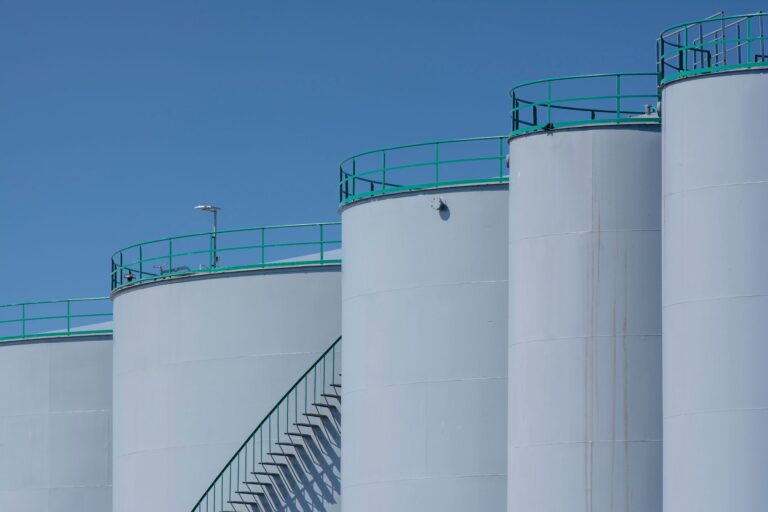
Gas customers in Germany are set to pay for a state emergency reserve – though far less than they once paid for the gas storage levy. The Economy Ministry under Katherina Reiche (CDU) has sent a draft bill dated 12 October to inter-ministry consultation. What it says, what it costs and what it means for this winter.
What a household would pay
The reserve is to hold 24 billion kilowatt-hours, about ten per cent of German storage capacity. It would be financed by a levy on all gas customers. The draft puts total costs at €247 to €308 million a year, for the first ten years according to Handelsblatt. Roughly 40 per cent falls on households and small businesses, about 60 per cent on industry.
For a typical household the draft gives €3.77 to €7.20 a year, depending on whether it uses 13,000 kWh (apartment building) or 20,000 kWh (detached house). For comparison, the storage levy still charged in 2025 was 0.289 cents per kWh – about €58 a year at 20,000 kWh. The new levy would be roughly a tenth of that. The first levy period starts on 1 October 2027; the market area manager sets the exact rate each year.
- Old storage levy: 0.289 ct/kWh, abolished on 1 January 2026 (federal government covers the cost)
- New reserve levy: €3.77–7.20 per household per year, from 1 October 2027 (per the draft)
- Total cost: €247–308 million a year
Not a volume problem, but a price one
The reserve has nothing to do with winter 2026/27: it is to be built up in 2027, after the law changes. Storage sites are currently more than 60 per cent full, according to dpa; in mid-September the figure was about 56 per cent, and the original 80 per cent target for early November is seen as unrealistic. Bundesnetzagentur president Klaus Müller said in mid-September: “We have no volume problem worldwide, we have a price challenge.” Storage held around 138 terawatt-hours, he said – more than was withdrawn over the whole of last winter. Minister Reiche also sees no gas shortage this winter.
The reserve would only be tapped in case of sabotage, a major event or the loss of key import routes, and only after the Bundesnetzagentur declares an emergency level. The draft models, among others, 20 days without Norwegian pipeline deliveries or 40 days without Germany’s LNG terminals. Reports differ on how long it would last: Handelsblatt writes of 30 days if the largest import infrastructure fails, dpa of 10 to 18 days of full supply if all imports stop. We did not have the draft text itself.
The levy is politically contested. Reiche floated funding from the federal budget or a mixed model in the summer, and Handelsblatt reports criticism of the levy from the coalition parliamentary groups, CDU/CSU and SPD. The industry group INES considers the reserve sensible but a public task that should be paid from the budget. Greens deputy parliamentary leader Julia Verlinden argues that with consistent renewable expansion, less expensive gas would need to be stored.
Our assessment: the sum is small for any one household, but it comes on top of grid charges and the gas price. Tenants with central heating will probably pay it through their heating bill. Whether the draft reaches cabinet unchanged is open – no cabinet date or consultation deadline has been named. For this winter, your own tariff matters more than the reserve: the consumer advice centre recommends watching prices and comparing tariffs, because higher grid charges can partly eat up the saving from the abolished storage levy.
Sources: Tagesspiegel/dpa, Handelsblatt, Verbraucherzentrale Niedersachsen, Stuttgarter Zeitung/dpa, ZDFheute