By Saturday evening it was clear that the “Gen Z regelt” protests drew far fewer people onto German streets than organisers had announced, and stayed peaceful almost everywhere. Only in Frankfurt did police end the march, at about 6.20pm. All figures are provisional (as of 31 October, around 7pm).
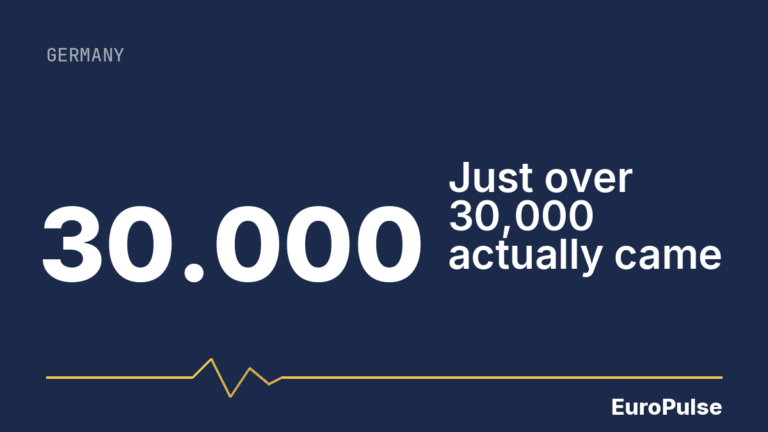
Between 160,000 and nearly 180,000 people had signed up online, depending on the day. The estimates published so far from the larger cities add up to a little over 30,000 participants.
| City | Participants (source) |
|---|---|
| Frankfurt | about 8,000 (police); organisers said 10,000 |
| Leipzig | about 6,000 (city authorities) |
| Berlin | peak of about 5,000 (police); organisers had expected 10,000 |
| Munich | about 4,000 (police, interim) |
| Freiburg | peak of about 3,500 (police) |
| Hamburg | a mid four-digit figure (police) |
| Cologne | “well” below the 15,000 registered, police said |
| Kassel | about 600 (police) |
Why Frankfurt tipped over
Frankfurt police had only expected around 2,000 people. The march set off at about 3.30pm from the Weseler Werft and was halted several times as firecrackers and pyrotechnics were set off and many broke the ban on face coverings. Hesse’s interior minister Roman Poseck (CDU) said the demonstration was ended “because of rioters and troublemakers”. Bottles and a few stones had been thrown; police used a water cannon and, in places, pepper spray. According to first reports, one person was injured by fireworks. Mubarik Sabir of “Generation Aufbruch”, who registered the march, had earlier said violence was ruled out.
In Cologne, too, police called off the planned march at short notice because of masked participants and pyrotechnics. The rally continued as a static event on the Rhine, and a water cannon was later used; reports give no clear trigger. In Berlin police reported one provisional arrest and a largely calm day. A counter-event at Rosenthaler Platz, where people from the far-left scene were expected, began at 5.30pm; the organisers had distanced themselves from it.
What the young protesters want
The spark came from France, where hundreds of thousands marched on 24 October for more school funding, with violence after dark in many places and about 70,000 security officers deployed. In Germany the initiative names better education, climate protection and affordable living as its concerns, along with opposition to conscription. The federal pupils’ conference (BSK) withdrew its backing on 24 October, citing opaque structures and the risk of political hijacking, and is planning its own demonstration on 20 November.
The teachers’ association VBE warns against treating the protests purely as a security problem. National chair Tomi Neckov said the demands match the association’s own and that teacher shortages and a repair backlog are real causes. “Democracy education does not happen on the side,” he said (“Demokratiebildung gelingt aber nicht nebenbei”). Compulsory schooling still applies, and how absences for protests are handled differs by state and school; the VBE wants clear rules from education ministries.
For the security services the evening was a test. Hesse’s interior ministry had warned of about 80 violence-prone left-wing extremists, and Bavaria’s interior minister Joachim Herrmann (CSU) wanted such structures stopped early. That the large-scale escalation seen in France did not materialise supports the line taken by cities such as Stuttgart, which saw no indication of violence beforehand and no legal basis for a ban.
Our assessment: the movement did not turn its online reach into mass turnout, but four- and five-figure crowds in several cities are notable for a call with no formal organisation behind it. What happens next will be decided in the coming weeks: the BSK demonstration on 20 November, whether the Frankfurt images narrow the debate to “riots”, and whether the states and Berlin respond to the education demands. We think a quick repeat on this scale is less likely than smaller local actions.
Sources: City of Stuttgart, hessenschau, Stuttgarter Nachrichten, News4teachers, Euronews