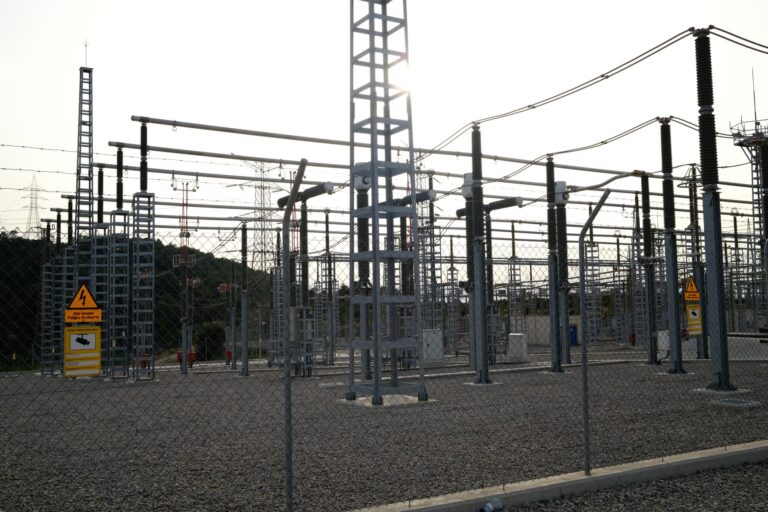
The ceasefire on strikes against energy facilities between Ukraine and Russia proposed by US President Donald Trump never entered into force, according to Ukrainian President Volodymyr Zelensky. “The energy truce is not working,” Zelensky said on Wednesday, 28 October, at a joint press conference with Dutch Prime Minister Rob Jetten in The Hague, as reported by the Kyiv Post. Ukraine had supported Trump’s proposal, Russia had not.
According to Zelensky, Russian troops massively attacked Ukrainian energy facilities the day after Trump’s initiative, whereupon Ukraine struck back. “When they attack our energy, we respond on energy,” he said. Accordingly, there is currently no mutual renunciation of attacks on energy infrastructure. The remarks come at a time when Washington is trying to advance negotiations between Kyiv and Moscow – including on limited ceasefires intended to pave the way for a broader peace settlement.
A few days of calm for the people in Oleshky
Zelensky assessed a separate humanitarian agreement mediated by the US for the Russian-occupied Oleshky in the southern Kherson region much more positively. According to the BBC, the local ceasefire entered into force on Tuesday, 27 October and is intended to enable humanitarian operations, including the evacuation of civilians from the sealed-off area. In the meantime, according to US First Lady Melania Trump, who had mediated the ceasefire together with Pope Leo XIV, it has been extended beyond Oleshky to other parts of the Kherson region in order to grant humanitarian convoys safe passage. According to the BBC, this was confirmed by the press spokesperson of the Ukrainian ombudsman and by Oleksandr Tolokonnikov, the deputy head of the Kherson military administration. Accordingly, Russian shelling has stopped both in the Ukrainian-controlled city of Kherson and in the wider region.
Zelensky welcomed the reduction in larger attacks. “We are even happy about two, three days for these people, you know, a certain ceasefire is great,” he said, noting that residents could be seen on the streets again. He thanked Washington for the mediation and stressed that the success of the humanitarian mission depended on the safe evacuation of civilians. “This is really their initiative,” he said, referring to the US. “We will see how it ends. Hopefully well.”
The situation in Oleshky remains desperate. According to the BBC, an estimated 1,700 to 2,000 people are trapped in the town itself, and several thousand more in the surrounding areas. Since the destruction of the Kakhovka reservoir dam in 2023, according to the BBC, there has been no electricity, no gas and no water, shops are closed, the roads are mined and the way out across the Dnipro is blocked. Many residents are said to be feeding themselves on weeds from their gardens. One woman told the BBC that she had stepped on a mine and had to undergo two operations.
Under the agreement, aid deliveries are to reach Oleshky first, after which the evacuation of those who want to leave the town is planned for Friday. According to MP David Arakhamia from Zelensky’s faction, the ceasefire applies until Sunday, 1 November, 22:59 Ukrainian time; he spoke of the “largest de-escalation since 2022”. How many people will actually go with them is open – a local volunteer told the BBC that by Tuesday afternoon around 500 people had expressed interest.
Dispute over the evacuation routes
It is disputed where the people will be taken. The Russian-installed head of the administration of the occupied parts of Kherson, Vladimir Saldo, declared that accommodation had been prepared in the region itself, in the annexed Crimea and in the Rostov, Krasnodar and Stavropol regions. Most residents wanted to stay in Russia, Saldo claimed – an account that cannot be verified on the ground. Zelensky warned that routes out of Oleshky cleared by Russia would lead to people “going in the direction of Russia and staying there”. Some would reach Ukrainian-controlled territory “one way or another”. The Ukrainian General Staff called on the population not to trust unconfirmed reports about routes, times and locations of convoys.
Ukrainian Foreign Minister Andrii Sybiha said, according to the BBC, that if the ceasefire produced results, it could “pave the way for further steps in the peace process”. The Kremlin had spokesman Dmitry Peskov say that everything was going “according to plan” and praised the US mediation.
Next round of talks in Abu Dhabi
Zelensky also announced a further round of trilateral negotiations with the US and Russia, to be held in Abu Dhabi between 6 and 10 November. At the technical level, practical steps to end the war are to be discussed and possible talks between the heads of state and government prepared. According to the Kyiv Post, the agenda includes ceasefire arrangements, energy infrastructure, security at sea, prisoner exchanges, the release of Ukrainian civilians held in Russia and the return of Ukrainian children. Kyiv had actually expected another meeting in Brussels, but Washington had postponed it. “We are waiting for the Americans,” Zelensky said, expecting more clarity after the US midterm elections.
He did not name a date for a meeting with Russian President Vladimir Putin. “I don’t know when we will have a meeting with Russia at the level of heads of state,” he said. The most sensitive questions – territorial disputes and security guarantees – would have to be dealt with directly by the heads of state and government. “We are also ready to talk about territories, but at the level of heads of state,” he said. “No one can negotiate about Ukraine without us.” Europe must be involved in a final settlement, even if European representatives are not initially present. “When we talk about security guarantees for Ukraine, then for me that cannot be without Europe.”
On the subject of winter aid, Dutch Prime Minister Jetten said his country would provide 500 million euros in military aid and 1.2 billion euros in non-military support over three years, including for energy infrastructure, healthcare and humanitarian needs. The Netherlands was also looking to partners within and outside NATO for additional interceptor missiles for air defence and wanted to increase missile production. “Every missile, even in smaller numbers, is useful today to protect Ukrainians,” Jetten said.
Editor’s note: The account that the energy truce never came about is based on Zelensky’s statement at the press conference in The Hague. Details of the events in Oleshky cannot be independently verified.