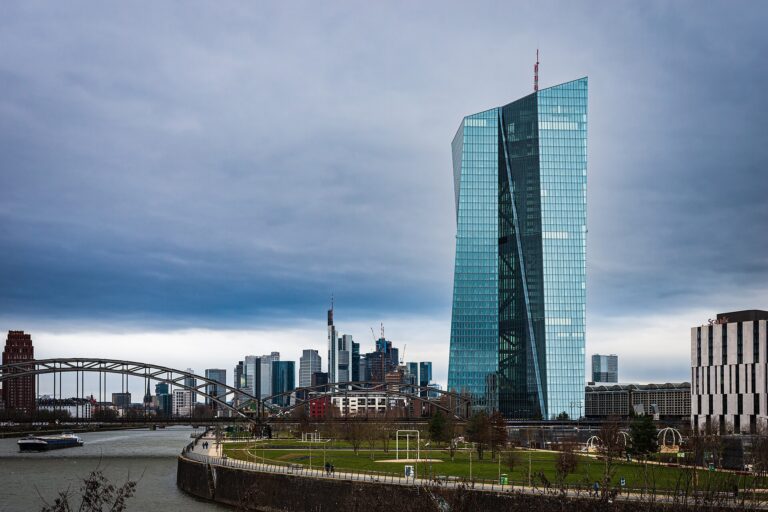
When the ECB Governing Council meets in Frankfurt on Thursday, almost nobody expects a rate rise. Nearly all economists surveyed predict a pause with the deposit rate at 2.50%. What matters is what Christine Lagarde says about December, and how far France shapes the debate.
Euro-area inflation hit 3.8% in September, according to Eurostat’s flash estimate, up from 3.2% in August and the highest since September 2023. Energy, up 18.8%, is the main driver. In Germany the Federal Statistical Office reported 3.3% on 13 October, with core inflation at 2.4%. Energy was 14.9% dearer than a year earlier, heating oil 74.9% and motor fuel 37.1%. Food barely moved, at +0.4%.
Two problems, one interest rate
The ECB raised the deposit rate by 0.25 points to 2.50% in September. In a Reuters poll of 73 economists, about 90% expect another step to 2.75% in December; 58% see that as the peak, while more than a third allow for up to 3.00%.
So why pause now? France. The yield on ten-year French government bonds rose above 5% on 21 and 22 October for the first time since 2002, touching 5.14%. The spread over German Bunds was roughly 170–178 basis points, the widest since November 2011. On 23 October Moody’s affirmed France’s Aa3 rating but cut the outlook to negative. Paris reports a 2026 deficit of 5.4% and debt of around 119% of GDP.
Higher rates make French debt dearer still, yet the energy shock leaves no room to relax on prices. UniCredit chief economist Marco Valli calls it “a narrow path between risks to inflation and to public finances”. Lagarde said, as reported by Euronews, that “the primary and first solution lies at home in France”, in fiscal policy. ING’s Carsten Brzeski put it this way: “The bond market has taken over the ECB’s job.”
Who pays the bill
Inflation does not hit everyone equally. An ifo Institute study of 10 August (CESifo Working Paper 12853) puts the extra household spending caused by the Middle East crisis at about €16.8bn. Disposable income falls by 1.15% on average: 2.87% in the lowest-income tenth, 0.65% in the highest. By our arithmetic the burden on the poorest is about 4.4 times as heavy. Pensioner couples lose 1.53% and single seniors 1.45%: no wages to catch up, and a larger share of the budget goes on heating and energy.
Andreas Peichl of ifo says the reason is that there is “no European price cap as in the 2022 energy crisis”. The authors stress the figures are an upper bound, since households cut consumption when prices jump. The study predates the September data, but with heating oil up 74.9% the pressure has probably grown.
Anyone with an oil boiler or a long commute feels it at once; tenants often see it only in the annual service-charge statement. That is our assessment, not a measurement.
Our view: a pause on Thursday is very likely. Whether December brings a hike depends less on German prices than on whether French yields calm down by then. It is far from automatic.
Sources: Federal Statistical Office, ifo Institute, Handelsblatt, cash-online (Reuters poll), FTD