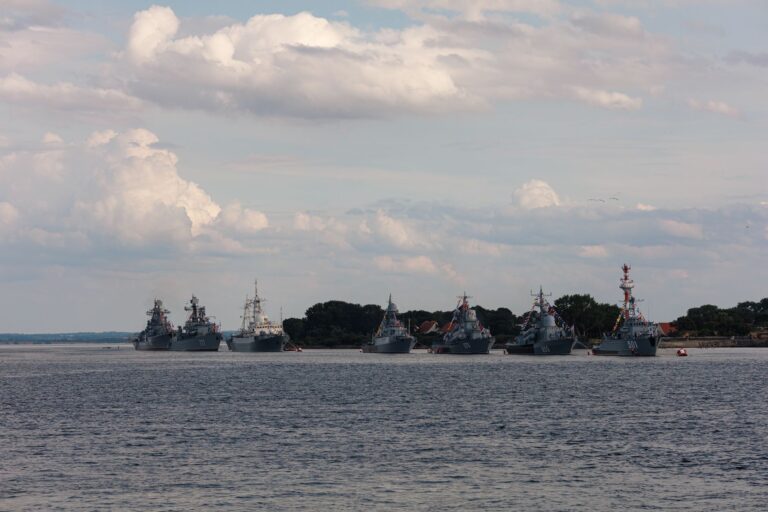
According to Ukrainian President Volodymyr Zelensky, Russia refused a mandate for de-escalation steps in the Black Sea and for a halt to attacks on Ukrainian energy infrastructure during the talks in Abu Dhabi. Zelensky said this on Thursday in a speech to participants of the ninth summit of the European Political Community, as reported by the news outlet Ukrainska Pravda. On Wednesday, 11 November, he had already made similar remarks to the press in Dublin.
“Unfortunately, the Russians said yesterday that they had no permission to talk about steps that could reduce the horrors of this war,” Zelensky said. This happened despite another attempt by the Ukrainian side to push through de-escalation in the Black Sea and an end to attacks on energy infrastructure. “But in response, our delegation heard that the Russian leader was angry and wanted to continue attacking.”
What was agreed in Abu Dhabi – and what was not
The delegations of Russia and Ukraine had spoken in Abu Dhabi on Tuesday and Wednesday about a peace settlement under US mediation, as reported by the Swiss broadcaster SRF. It was the first meeting in the trilateral format of the USA, Russia and Ukraine since February. According to Russia’s chief negotiator Vladimir Medinsky, the central issue was a future European security order. “On some points we reached an understanding, on others not,” Medinsky said on Russian state television.
One result is certain: both sides agreed on a large exchange of prisoners of war. According to Russian Lieutenant General Alexander Sorin, as reported by the Russian news agency Tass, more than 1000 prisoners are to be exchanged on each side – in the coming two to three weeks. Der Spiegel reports, citing Tass, that it could be the largest exchange so far; the details have not been officially confirmed. According to Tass, the second round of talks on Wednesday lasted less than two hours and was therefore shorter than the opening session the day before.
Europe at the table – but how?
US negotiator Jared Kushner, son-in-law of President Donald Trump, said in Abu Dhabi that the Europeans must be at the table; the EU and Nato must become an “integral part” of negotiations on ending the war. Medinsky, however, rejected participation by European states in future talks for the time being: “We have not received a single peace initiative or a single concrete peace proposal from the European countries, so it is unclear what we should discuss.”
Der Tagesspiegel reports that representatives of Germany, the United Kingdom and France were present in Abu Dhabi but did not take part directly in the talks. According to Süddeutsche Zeitung, the security advisers of Germany, France, the United Kingdom and Italy as well as the head of office of the European Commission president attended the consultations. Italy’s Prime Minister Giorgia Meloni demanded that the Europeans speak with one voice; the German government sees itself in a key role.
What happens next
According to Kushner, the US envoys Steve Witkoff and Jared Kushner planned to travel to Moscow on Thursday to meet Putin and then “brief” Zelensky in Dublin. Der Tagesspiegel reported on Thursday, citing several news agencies, that Kushner and Witkoff had already arrived in Moscow for talks with the Russian president; Putin’s special representative Kirill Dmitriev had received the US delegation at the airport.
Ukrainian negotiator David Arakhamia spoke of very “tough” negotiations and said the Russian delegation had arrived with “strict directives”. He considers a “solution before the new year” possible. Kushner described the talks as a “first good step”. According to the news agency RIA, Russian Deputy Foreign Minister Sergei Ryabkov said there was a basis for further work. Zelensky said on Wednesday evening in Dublin that there was currently a window of time in which all participants sincerely wanted to achieve a result before 2027, and hoped that Witkoff and Kushner would bring “something concrete” from Moscow.
For Ukraine, the sequence remains decisive: first the end of the war, then security guarantees, and only after that a dialogue on security in Europe and the world – that is what Zelensky had demanded before the second day of negotiations. Whether Moscow will agree to this remains open according to his account on Thursday. One thing is clear: on the question of de-escalation in the Black Sea and an end to attacks on power plants and grids, there was no commitment in Abu Dhabi.