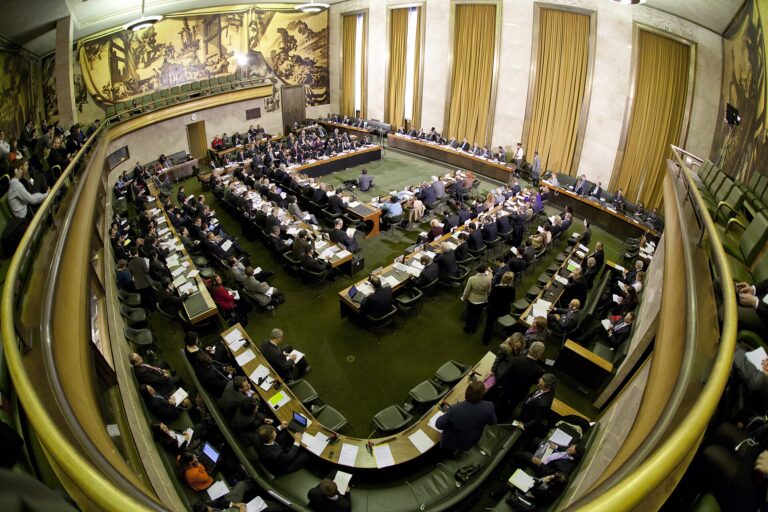
From this Monday, 128 states parties to the UN Weapons Convention (CCW) are meeting in Geneva to discuss regulating autonomous weapons systems, often referred to as “killer robots”. According to the Austrian broadcaster ORF, the review conference runs until Friday, 20 November. After 13 years of non-binding talks, Switzerland is now to see a first step towards a framework treaty.
Der Tagesspiegel speaks of a “decisive round” and a “showdown over the future of warfare”. According to ORF, most CCW states favour a ban on fully autonomous weapons systems that are entirely removed from human control, as well as clear rules for systems with individual autonomous functions. Fully autonomous means: a drone or missile not only seeks and tracks targets itself according to algorithms, but also launches an attack without human control.
US and Russia put the brakes on
According to ORF, opponents of a ban include the US, Russia, India and Israel. Der Tagesspiegel also names Belarus and North Korea, which, together with the Russians and the Americans, spoke out against opening negotiations in the UN General Assembly. CCW decisions are taken by consensus – every country therefore has a veto.
The non-governmental organisation “Facing Finance” accuses Moscow and Washington of “permanently preventing” substantive negotiations. One negotiator told Der Tagesspiegel: “The US and Russia will not allow themselves to be tied down, least of all on new weapons systems.” According to the report, diplomats confirm that both states want to play their technological trump cards to the full in their wars.
Ahead of the conference, UN Secretary-General António Guterres and the President of the International Committee of the Red Cross (ICRC), Mirjana Spoljaric, had called for the start of serious treaty negotiations. “We are now dangerously close to crossing a moral red line: the autonomous targeting of humans by machines,” Der Tagesspiegel quotes the two as saying. According to Der Tagesspiegel, 163 countries called in the UN General Assembly for a limitation agreement to finally be set in motion in Geneva.
Already in use today – and barely defined
Those affected would include AI-supported autonomous combat drones, which according to Der Tagesspiegel are already being used in Ukraine and Sudan. Israel, too, is said to use AI-supported systems for target selection in the Gaza war, but denies using fully autonomous killing weapons. ORF, citing the news outlet Swissinfo, points to 6 July of this year: in the Ukrainian city of Zaporizhzhia, a Russian drone killed three people at the time. Swissinfo called this the first documented incident of a weapon fully controlled by artificial intelligence that accidentally killed people.
There is as yet no legally binding definition of “lethal autonomous weapons systems”. According to Der Tagesspiegel, a group of government representatives at the UN describes them provisionally as: systems that “identify, select and attack a target in a way that results in the loss of life, without the intervention of a human who operates the system”.
The Stockholm peace research institute Sipri writes in a current study: “Military AI is big business, and many companies, new and old, want to secure a piece of the cake.” Der Tagesspiegel’s enquiries to Rheinmetall, Helsing and Stark have so far gone unanswered.
A two-stage approach instead of an immediate ban
According to Der Tagesspiegel, Austria, Ireland and Belgium insist on the broadest possible outlawing. Germany, together with France, is relying on a two-stage approach: “On the one hand a ban on fully autonomous weapons systems that operate entirely outside human control, on the other hand regulation of weapons systems with autonomous functions.” Austria’s foreign ministry explains on its website that “meaningful human control” over autonomous weapons systems is necessary; the question is one of the “most current and urgent disarmament challenges”.
According to ORF, the ICRC is calling on CCW states to “adopt legally binding rules that prohibit unpredictable autonomous weapons as well as those designed to directly exert violence against people”. The “Stop Killer Robots” coalition, an alliance of more than 300 non-governmental organisations in more than 70 countries, describes the seventh CCW review conference as possibly the “most consequential of our time”. It demands a mandate for negotiations on a new, internationally legally binding protocol to be negotiated by the end of 2027.
Cordula Droege, director for international law at the ICRC, warns according to Der Tagesspiegel: “An increased tempo of operations increases the risk of misjudgement and error, and these can endanger both civilians and one’s own armed forces.” Thomas Küchenmeister of Facing Finance says “that the mere availability of autonomous combat robots will significantly increase the probability of armed conflict”.
According to ORF, it is possible that the states will adopt a negotiating mandate but leave open whether the outcome should be legally binding. According to Der Tagesspiegel, diplomats in Geneva are already discussing scenarios for negotiations without the US and Russia. Küchenmeister: “If nothing decisive happens at the Geneva talks in the direction of a binding ban, the opponents of killer robots have the option of starting negotiations outside the UN Weapons Convention.” If strong regulation came about without the blockers, they would not be bound – and would have a free hand in the use of autonomous weapons.
The editorial assessment: The conference is a test case for whether the CCW’s consensus principle still offers protection or leaves the regulation of war to the states that want to wage it.