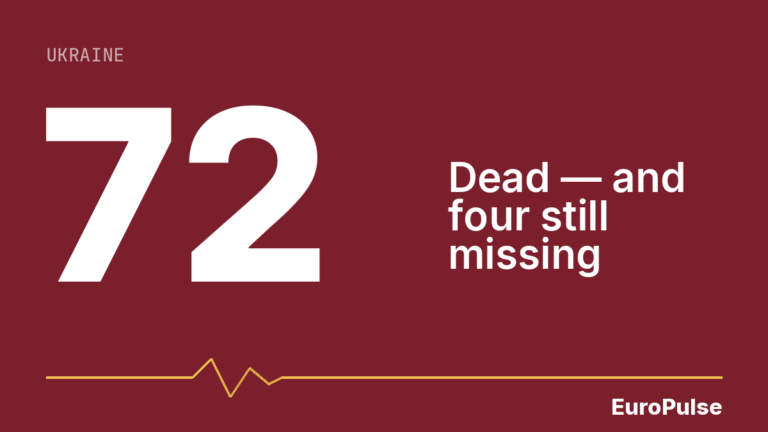
Two weeks after the Russian air strike on Komyshuvakha in Ukraine’s Zaporizhzhia region, the search of the rubble is over. Ukrainian officials put the death toll at 72 (as of 16 November 2026), 17 more than we last reported. Four people are still listed as missing and four of the injured remain in hospital; UNIAN reports that a fifth injured person has since died.
Mykhailo Semikin, acting head of the regional military administration, wrote on Telegram that by the number of dead this is “the most terrible strike on Zaporizhzhia region” and one of the deadliest in Ukraine, a tragedy that will “remain a pain” for the region and the country. According to Ukrinform, Interior Minister Ivan Vyhivskyi listed the victims on Facebook: emergency workers and police officers, staff of a gymnasium and an administrative services centre, municipal employees and medical personnel. Among the dead is a teacher who regularly came to the shelter to give online lessons to evacuated children.
To recap: on 2 November Russian guided bombs first hit a gymnasium, and about an hour later, according to Ukraine’s military intelligence (HUR), a FAB-3000 struck the underground rooms where roughly 100 people were. A CNN investigation based on police bodycam footage and munition fragments described it as a “double-tap”: the second blow came after rescuers and people seeking shelter were already on site.
The recovery work itself came under fire. Ukrinform says Russian forces hit the settlement 11 times over the past two weeks, nine of them aimed at the search site; three police officers and four rescuers were injured and equipment was damaged. At times teams could work only 15 to 20 minutes at a stretch. Forensic experts ran dozens of DNA tests because many victims could not be identified otherwise: on 8 November only 29 of 55 bodies had been named.
The sources differ in detail. Ukrinform credits Vyhivskyi with the overall figure, while UNIAN and Radio Svoboda quote Semikin; the number, 72, is the same everywhere. The site is variously called a school, a humanitarian hub or a shelter. It seems to have been all three: an underground building where aid was handed out and people sheltered, earlier described as the last relatively safe place in the village.
Kyiv says it already knows who is responsible. On 7 November HUR named Colonel Fedir Zubakov, head of a fire-strike group on the staff of Russia’s “Dnipro” force grouping, as the planner, along with four Su-34 bombers and six pilots. These claims are not independently verified; Moscow denies deliberately targeting civilian infrastructure.
Our assessment: with the search closed, the legal phase begins. Names and units are a precondition for war-crimes investigations, possible trials in absentia and targeted sanctions, though none of that is likely to change quickly what life looks like in Komyshuvakha, a few kilometres from the front. The toll could still rise slightly while the four missing remain unaccounted for. Latvia had already asked for a special UN Security Council meeting; whether that yields more than statements is an open question.
Earlier coverage: Komyshuvakha: 29 of 55 victims identified.
Sources: Ukrinform, UNIAN, Radio Svoboda, Kyiv Independent (HUR)