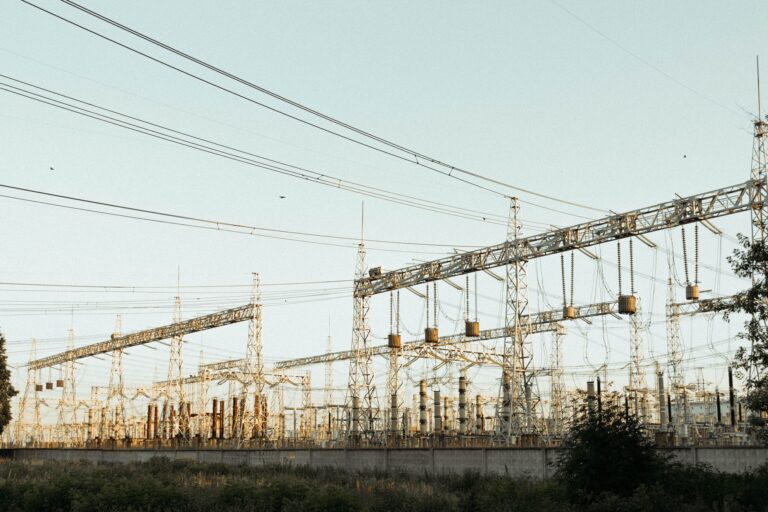
In Kyiv Oblast, none of the 26 protective structures intended to shield substations from Russian drone and missile attacks has been completed – although all the work should have been finished by 1 October 2026. BBC News Ukraine reports this, citing the parliament’s temporary special commission on critical infrastructure and energy resilience. The State Police of Kyiv Oblast has been investigating the unfinished construction for months.
According to that report, between April and July 2026 more than 80 per cent of the contracts – 23 of the 26 sites – went to just two companies: “Konsaltynh-Bud”, owned by the entrepreneur Liubomyra Kozhushko, and “Yu.Bi.Si” of Ihor Nesteruk. Together the two companies received contracts worth 1.84 billion hryvnias. The MP Yaroslav Zhelezniak wrote on Telegram that the owners lived “in one family”, as recorded in a 2024 ruling of the anti-corruption court. As a subcontractor, Vladyslav Sokolov supplied metal – the same entrepreneur whose house caused a stir during searches with gilded columns, marble, a covered pool and a crocodile in a terrarium.
The construction work fell during the tenure of the current Minister for Reconstruction, Infrastructure and Transport, Mykola Kalashnyk, who headed the oblast until 16 July 2026. Kalashnyk rejected the accusations: when he ended his post as head of the oblast administration, the construction readiness of the protection at the 26 substations had been 40 per cent, and today it stands at 55 per cent, he said before journalists on 14 November. “I bear responsibility for the decisions we made when I headed the oblast.” At the same time he conceded that the work was proceeding “under conditions of a funding deficit”.
No site finished, only 2.8 per cent accounted for
According to Zhelezniak, the oblast administration concluded the 26 contracts without a tender. Only 23 million hryvnias have so far been accounted for as completed work – 2.8 per cent of the total sum. Representatives of the construction companies stated in a closed session of the special commission that the money had not been enough; the work was 45 to 50 per cent done. The MP Oleksii Kucherenko wrote on Facebook that the construction companies were now demanding an additional 400 million hryvnias, but had three times been unable to say clearly whether they could complete even some of the 26 sites without additional funds. “The schedules have already been changed three times, and none was met,” Kucherenko said. The entire relationship between the client and the construction companies had been built “predominantly on verbal agreements and promises”.
Sokolov said in a video message that his companies “Stal Plius” and “TD Trysub” had no direct contract with the oblast administration; Kozhushko’s companies had not paid him more than one billion hryvnias for steel supplied. The work had proceeded on the basis of verbal assurances from Kalashnyk. According to the commission members, Kozhushko herself did not comment; they suspect she is keeping silent because of other investigations. At the time the funds were awarded, she was already a suspect in several criminal proceedings – including over a shelter for a lyceum in Kriukivshchyna and over drones for the State Special Communications Service. The High Anti-Corruption Court imposed a bail of millions on her and increased it because, in the court’s view, she violated the condition not to speak with suspects and witnesses.
Why the protective structures are needed at all
The idea of physical protection around substations arose in the first years of the war, when Russia damaged large parts of Ukraine’s energy generation. Ukrainian specialists developed the projects together with military engineers from the USA, the United Kingdom, Germany, Japan and Israel; foreign specialists also took part in tests. The first level of protection consists of sandbags and gabions, the second of concrete structures and nets against kamikaze drones, the third of massive reinforced-concrete sarcophagi against missiles. The third level was never completed because of the high costs, although the then Prime Minister Denys Shmyhal repeatedly spoke in 2024 of a readiness of 85 per cent. In 2025, when Russia changed its tactics and attacked smaller substations in the regions, the cabinet decided to give local authorities money so that they could find construction companies themselves and conclude contracts.
In mid-October, the oblast administration asked the government to transfer the sites to the Reconstruction Agency so that it could decide on the further construction. According to the special commission, the agency cannot currently do so because the necessary documentation for the transfer is missing – it was simply never kept.
The MP Zhelezniak summed up the consequences as follows: “In effect, they have gambled away the protection of light and warmth for the homes of tens of millions of our citizens before the winter.” The commission directs its questions above all at the former leadership of the oblast administration: why did it conclude contracts with a person who was already a suspect in several criminal proceedings at the time? A conclusive answer to this has so far not been given; the former heads of the administration point to one another when asked about responsibility. The scandal is therefore unlikely to be over – activists, investigative journalists and the special commission have further questions about the use of almost two billion hryvnias.