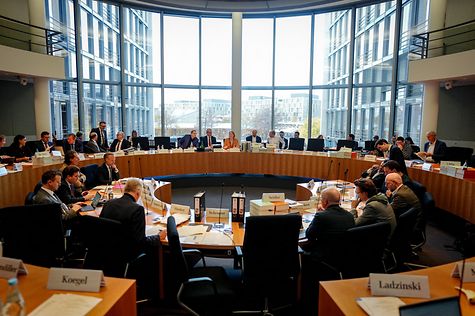
The Bundestag’s budget committee passed the 2027 federal budget in the night to Friday. As budget politician Sebastian Schäfer (Greens) told the news agency AFP on Friday morning, the core budget provides for spending of 555.436 billion euros. The budget thus lies somewhat above the 555.4 billion euros that Finance Minister Lars Klingbeil (SPD) had estimated in his draft in September.
Planned borrowing is also rising significantly: according to the agreed budget, net new borrowing in the core budget is to amount to 122.972 billion euros – after 98 billion euros this year. Together with the debt-financed special funds for infrastructure and climate neutrality as well as for the Bundeswehr, new debt in the coming year adds up to around 210.413 billion euros, according to the taz. This sum will continue to rise in subsequent years and will lead to annual interest payments in the double-digit billions. The federal government justifies the high amounts above all with the international economic and security situation, such as the consequences of the wars in the Middle East and in Ukraine, which it says make massive investment in defence capability necessary.
Electricity tax stays for now, plastics tax off the table
Late on Wednesday evening, the Union and SPD had agreed on key disputed issues ahead of the decisive deliberations. The promised reduction of the electricity tax for all is initially not coming, because according to the taz the roughly 5 billion euros needed for it cannot be offset. After massive resistance from business, the plastics tax is now not to come after all, and the sugar tax is to be postponed by half a year to 2028. Cuts originally planned in the social sector were softened.
Before the session, committee chair Lisa Paus (Greens) described in the ARD capital studio how the budget was being fine-tuned until the last moment. One after another, all ministers would have to answer questions from the committee, she told the ARD capital studio. “Everyone is well advised to be there at least an hour before their expected slot,” Paus said. Anyone who arrives late faces “corresponding deductions in the budget”. Traditionally, the reconciliation session lasts until the early morning hours; last time it was “shortly before 6 o’clock”.
“A slap in the face for the chancellor from the vice-chancellor”
There was sharp criticism from the opposition. “The 2027 federal budget itself becomes a major future risk,” Schäfer told AFP. “Instead of consistently investing in infrastructure, climate protection and economic strength, the coalition is abusing the special fund to plug its budget holes.” The chancellor had “put a reduction of the electricity tax in the shop window for months and then fails to deliver”. Left Party budget politician Dietmar Bartsch told AFP: “The chancellor wanted to lower the electricity tax. This budget does not even deliver that to citizens.” That was “nothing less than a slap in the face for the chancellor from the vice-chancellor, who once again stands there as an announcement chancellor”. The coalition had “lost its way in a debt labyrinth that brings citizens only one thing: astronomical interest payments and, in the coming years, rising taxes alongside cuts”.
Even before the agreement, Left Party parliamentary group leader Sören Pellmann had called the draft a “future killer”; the budget was not socially just, too much money was flowing into armament, tagesschau.de reported. AfD leader Alice Weidel criticised the planned high new borrowing: if anyone should tighten their belt, “then it is the voracious tax and levy state”.
What happens next
Klingbeil had introduced the draft in the Bundestag on Tuesday, 8 September 2026, and in doing so campaigned for more “location patriotism”. For 2027 it provided for 118 billion euros for investment, 17.7 billion euros for rails, bridges and roads, and 9 billion euros for digitalisation. The defence budget was to rise by 27.1 billion euros to 109.7 billion euros. The minister defended taking on new debt with the words: “To defend yourself without new debt is like flying to the moon without a rocket.”
Attention now turns to the coalition committee on Tuesday, as the taz reports. From this Friday, the working group on tax estimates is also deliberating on how much tax revenue the federal government and the states can expect, tagesschau.de reported. The planned new debt is likely to continue to fuel discussion even after the reconciliation session.