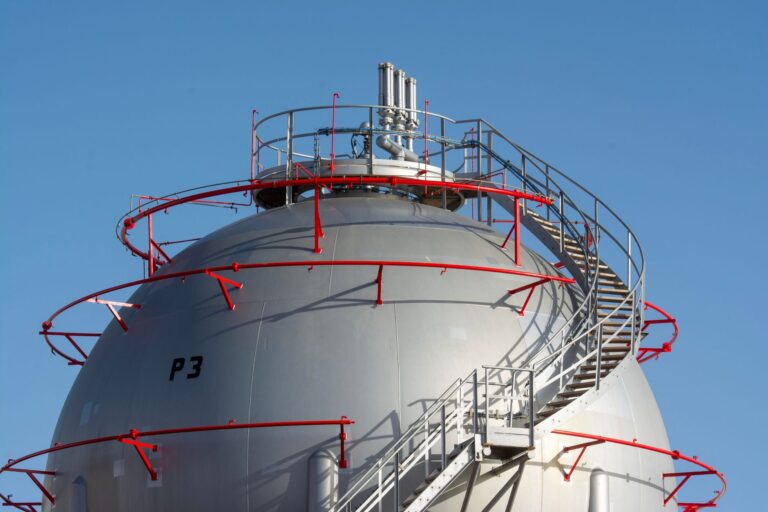
The German government wants a strategic gas reserve to cushion crises such as sabotage. On Wednesday the federal cabinet approved the creation of a national gas reserve. According to the Federal Ministry for Economic Affairs, the reserve is to comprise 24 terawatt hours and hold additional physical gas volumes that may be used exclusively in the event of the emergency level, as MDR reports. It is based on a draft law by Federal Economy Minister Katherina Reiche (CDU).
“The past few years have shown us how quickly a supposedly secure energy supply can falter,” Reiche said, according to tagesschau.de. The reserve is intended to create an additional safety buffer. “The strategic gas reserve does not insure us against high prices, but against crisis situations.” The draft law refers to extreme cases, sabotage and rare major events. The reserve is expressly not intended to be a replacement for the market mechanism in filling the gas storage facilities – market participants continue to bear full responsibility for winter precautions and their supply obligations.
What the reserve costs consumers
The build-up is to take place as quickly as possible but can be stretched over up to three years if needed. Gas purchasing, transport and storage capacity are initially to be financed through a KfW loan; in the end, according to the ministry, end customers will pay through a levy. The first “levy period” is to begin on 1 October 2027.
According to tagesschau.de, the draft law quantifies the consequences: for a typical household in an apartment building with annual consumption of around 13,000 kilowatt hours, the levy means annual costs of 3.77 to 6.11 euros; for a household in a detached house with 20,000 kilowatt hours, 5.80 to 9.40 euros. Gas procurement costs would thus rise by 0.3 to 0.5 per cent. Total costs are estimated at 247 to 405 million euros per year, borne around 40 per cent by household and commercial customers and around 60 per cent by industrial customers. MDR converts the levy to 0.03 to 0.05 cents per kilowatt hour; with a gas price currently averaging eleven to twelve cents per kilowatt hour, that means an increase of under ten euros per year for a detached house with 20,000 kilowatt hours.
The levy is controversial within the governing parties. The industry association BDEW welcomed the reserve in principle but spoke out in favour of financing from the federal budget. This would be appropriate, it said, because the reserve benefits not only gas customers but the entire economy.
Filling-level requirements expire in March 2027
The existing requirements on gas storage filling levels will not be extended and are to expire at the end of March 2027. This year they were missed: by 1 November an average filling level of 70 per cent was effectively to be reached, but this target was not met. A spokesperson for the Federal Ministry for Economic Affairs had stressed that the gas supply was secure for the winter.
The Economy Ministry and the Federal Network Agency point out that gas storage facilities have lost importance in view of additional imports of liquefied natural gas. “Yes, the gas storage facilities are currently less full than in previous years, but storage levels no longer alone determine our security of supply today,” Reiche said, according to tagesschau.de. According to MDR, the head of the Federal Network Agency, Klaus Müller, has again assured that the gas supply is secure this winter and that the storage filling level is no longer so important.
The figures on the filling level diverge in the reports: MDR currently cites 32 per cent in German gas storage facilities, elsewhere in the same report 61 per cent nationwide and almost 86 per cent for Saxony-Anhalt. Saxony’s Energy Minister Willingmann assesses the supply in Saxony-Anhalt as stable; according to the report, the state hosts more than a fifth of the stored gas.
According to the ministry, the federal government also intends to examine options for targeted relief for particularly energy-intensive companies and to take further crisis-prevention measures. Suppliers are to be obliged to make winter precautions. In the course of a planned EU energy security framework, the Economy Ministry says it is examining tightening gas suppliers’ responsibility for adequate supply to their customers; this should enable “supplier obligations backed by sanctions”, according to a ministry paper available to the Deutsche Presse-Agentur and reported on by the Berliner Zeitung.
Editor’s note: The draft law still has to pass the Bundestag and the Bundesrat. The levy would affect gas customers only from October 2027 – and, according to the figures estimated in the draft, only in the single-digit euro range per year.