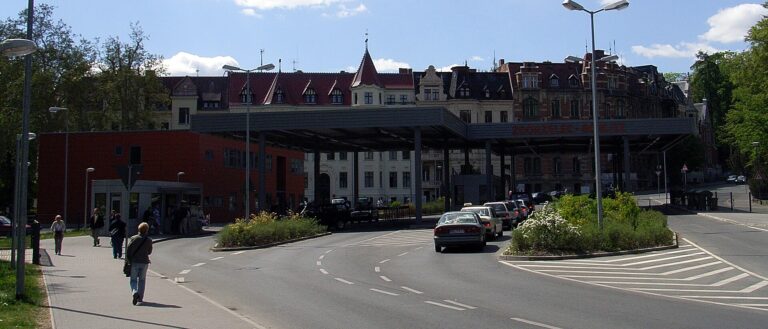
A 38-year-old German-Pole from Görlitz has won his case against the German border checks at the border with Poland at the Dresden Administrative Court. As he told ntv.de in an interview, the court declared unlawful the check to which he was subjected on 25 September 2024 on the town bridge between Zgorzelec and Görlitz. Jakub Woliński, who grew up in Zgorzelec and now lives with his family in the Saxon town of Görlitz, said: “I constantly have to explain myself as if I were a criminal.”
According to him, the trigger for the lawsuit was that check, during which the federal police recorded his personal details and searched his car. “From the outset I considered the border checks unlawful,” Woliński told ntv.de. Since the reintroduction of the checks on 16 October 2023, the requirements of the Schengen Borders Code had not been met, he said. He had therefore looked for a legal route. When he heard about the case at the Austrian-Slovenian border, in which a claimant had gone all the way to the European Court of Justice, “the common thread” was there.
A partial victory – and what it means for everyday life
For Woliński, the ruling is not a final success. “I want to emphasise expressly: this is only a partial victory,” he told ntv.de. “The joy was there nonetheless, but the checkpoints in my homeland are still standing.” The checks are a burden above all for his family life. He holds German and Polish citizenship and wants to familiarise his children with both cultures. “You can no longer tell them in good conscience that Poland and Germany are friends. Friends don’t face each other with weapons and checkpoints, do they?” he said. Even visits to his parents on the Polish side had become a problem: “When I drive to my parents’ house to feed the cats or water the garden because they are on holiday, I have to disclose my whole life.”
In December 2024, according to him, he and his wife had to wait two hours during another check; later the police reported him for allegedly having recorded the conversation. The police recordings of the incident were also submitted as evidence in the proceedings in Dresden, Woliński said.
Dobrindt wants to appeal – the checks continue
Federal Minister of the Interior Alexander Dobrindt (CSU) justifies the checks with the fight against irregular migration and people-smuggling crime. Woliński considers the measures disproportionate. “If the checkpoints work so wonderfully, why not set them up between the federal states too? Criminals move around within Germany as well,” he told ntv.de. Germany must abide by applicable European law. He referred to Article 22 of the Schengen Borders Code, under which internal borders may in principle be crossed without checks on persons.
At the same time, he criticised the Federal Government’s account to the European Commission that no traffic disruptions of more than 30 minutes caused by the checks had been observed. According to him, the Polish motorway authority GDDKiA, in response to a request by Sejm MP Marta Stożek, reported more than 120 such disruptions at just one border crossing on the A4 motorway. The Lower Silesian voivode and the marshal of the Lubusz Voivodeship also contradicted this account, Woliński said. “That doesn’t add up!”
The Federal Ministry of the Interior intends to challenge the ruling; the border checks will continue, as “Welt” reports. As early as Friday, 13 November, according to MDR Sachsen, the ministry had announced an appeal and stated that it would carefully evaluate the written grounds of the judgment once they were available. In the ministry’s view, the internal border checks are lawful. The appeal would have to be decided by the Saxon Higher Administrative Court in Bautzen.
The Dresden Administrative Court ruled in two judgments that the internal border checks ordered by the Federal Ministry of the Interior at the borders with Poland and the Czech Republic were unlawful, as the court announced in a press release according to “Focus”. The two lawsuits had been combined into one set of proceedings. Besides the Görlitz case (6 K 2335/24), the proceedings concerned an identity check on 18 May 2026 at the Breitenau border crossing on the A17 when entering from the Czech Republic, against which a man from Michendorf in Brandenburg brought a claim. These were actions for a declaration of continuation: the court only establishes whether the specific checks were unlawful – this does not automatically entail compensation, court spokesman Markus Walther said.
The claimants’ lawyer, Christoph Tometten, demanded after the ruling: “The Federal Government must stop the border checks immediately.” The Federal Government had for years made “excessive use” of the exception for internal checks, he said. According to “Focus”, similar rulings had already been handed down in Bavaria and Rhineland-Palatinate. Checks have been carried out at the Saxon borders with Poland and the Czech Republic since October 2023; in 2024 stationary checks were introduced at all German national borders; the measures are time-limited but have repeatedly been extended.
The editorial assessment: The Dresden ruling is not final until the decision in Bautzen and for now changes nothing in practice on the Neisse. For the people in the twin town of Görlitz/Zgorzelec, everyday life therefore remains shaped by checks – and for Woliński the partial victory is above all a signal that the courts assess proportionality differently from the Ministry of the Interior.