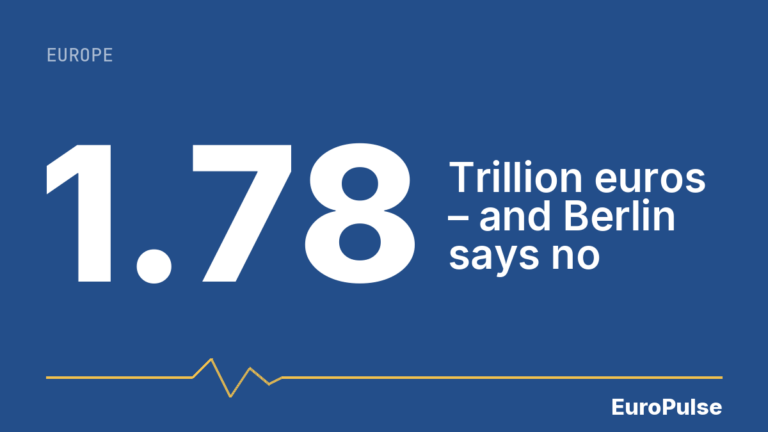
European Council President António Costa unveiled his compromise for the EU’s 2028–2034 budget in Brussels on Saturday – and Chancellor Friedrich Merz said no almost at once. “The proposal now on the table is a first step, but the volume is still too high,” Merz said. It is about more than numbers: Berlin is tying its consent to funding for Ukraine.
Costa’s draft totals €1.781 trillion (€1.582 trillion in 2025 prices). That is about €204 billion, or just over ten per cent, below the Commission’s July proposal (€1.985 trillion). Yet it saves only about €44 billion compared with the Irish presidency compromise that collapsed at the October summit. National contributions would rise from 0.80 to 0.82 per cent of gross national income, according to Costa.
The novelty is a digital levy: 3 per cent on revenue from online advertising, platform services and the monetisation of user data, for groups with more than €750 million in global turnover and €50 million in EU digital revenue (Handelsblatt reports €60 million). It should raise a little over €5 billion a year; new own resources overall are meant to yield more than €60 billion annually. It replaces the Commission’s corporate levy, which the German government called unacceptable because it would have hit large German firms.
Merz’s objection is one of principle. In September he said in Berlin that the Commission’s plans meant a 60 per cent increase, that cuts of “several hundred billion euros” had to affect “all areas”, and that he rejects new joint debt. Germany pays more than a fifth of the budget and, with Sweden, Denmark, the Netherlands, Austria and Finland, leads the group of frugal states.
The second front is Ukraine. With the Czech Republic, Slovakia and Hungary (and, per ZDF, Bulgaria) unwilling to back an EU loan for Kyiv, Merz threatens to block the budget unless all 27 states commit to “robust and sustained multi-year support for Ukraine”. Brussels puts the 2027 gap at roughly €70 billion; President Zelensky puts Ukraine’s total 2027 needs at €155 billion. Robert Fico called Merz’s line “blackmail”; Andrej Babiš said Ukraine aid cannot be a precondition.
Pressure comes from the other side too. The Élysée called the draft “very disappointing”, mainly over farm aid, and saw no basis for a deal. Poorer cohesion countries fear losing regional funds. According to EUobserver, Macron has said there will be little political room for a deal from January – France votes in spring.
Our assessment: the special summit on 26–27 November is unlikely to deliver a breakthrough – the budget needs unanimity and nearly every capital loses something. A deal is realistic at the regular summit on 17–18 December at the earliest, perhaps only with a separate fix for Ukraine in 2027. Much depends on whether Prague, Bratislava and Budapest give way; that is far from certain.
For Ukrainians living in Germany nothing changes directly – residence status and benefits are set by the federal government and the Länder. But whether Kyiv gets dependable EU money in 2027 will be decided in exactly this fight.
Sources: ZDFheute, Handelsblatt, Nordkurier/dpa, Bundesregierung, Yevropeiska Pravda