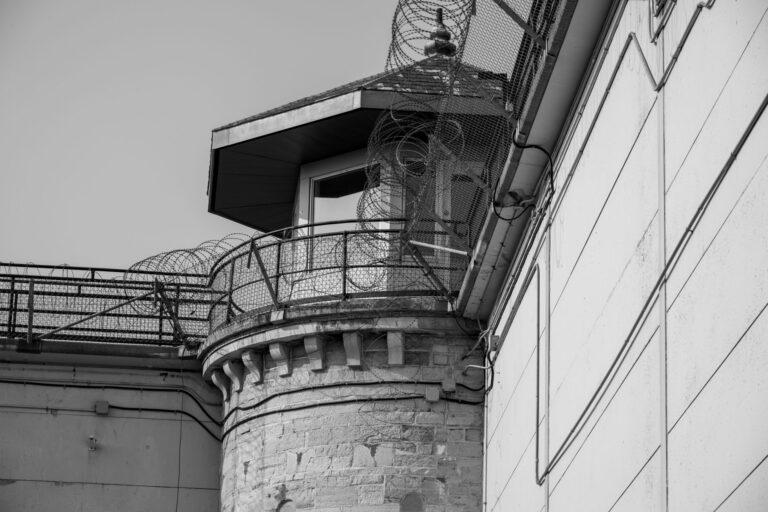
Thuringia plans to increase the capacity of its pre-deportation detention facility from ten to 15 places. Migration Minister Beate Meißner (CDU) announced this on Thursday in a government statement in the Thuringian state parliament. The municipalities had signalled that they needed the additional places, Meißner said according to a report by the German Press Agency (dpa) published by zeit.de. The facility is considered one of the most symbolic projects of the coalition of Minister-President Mario Voigt (CDU) made up of the CDU, Thüringen.Gerecht and the SPD – and above all as a flagship measure of the Christian Democrats.
Meißner placed her government statement under the heading “We love the rule of law”. In migration policy, she compared her approach to two sides of a coin: it was about order and integration. For the coming year, she announced “charter measures”. Thuringia had also already registered its participation in collective returns, i.e. joint deportations.
More voluntary departures, thousands of returns since 2023
According to the minister, the number of voluntary departures from Thuringia has risen – from 269 in 2023 to 537 last year. Between 2023 and 2026, almost 3,000 people were returned to their home countries, through voluntary departure or deportation. From January to July 2026, according to Meißner, 288 deportations were carried out in Thuringia, 15 per cent more than in the same period the previous year with 250. In the same period, 1,241 refugees came to Thuringia, 38 per cent fewer than a year earlier.
According to Meißner, deportations often fail because of missing documents. “Deportation to the country of origin is only possible with a replacement passport,” she said. According to her, just under 4,000 people from abroad currently live in Thuringia with a Duldung (tolerated stay). For just under 1,000 of them, missing documents were the reason for the Duldung, and for a further around 200 the identity was unclear.
Federal government takes over passport procurement – relief for districts
From 1 October, the federal government will take over passport procurement for Thuringia as part of administrative assistance. “Until now, every district was on its own and had to spend a great deal of effort and time on this,” said Meißner. The federal government had better contacts with foreign missions and authorities abroad than the municipal foreigners authorities. So far, only Bremen, Saarland and Brandenburg had concluded such a far-reaching agreement with the Federal Ministry of the Interior. Meißner expects this to bring more speed in deportations, relief for the municipalities and cost savings.
Until now, individual districts were responsible for contact with specific countries of origin – for example the Wartburgkreis for Turkey, Weimarer Land for Afghanistan and Sonneberg for Syria. This will cease in future. The agreement only became possible after the state government had created a central foreigners authority for the Free State. People without documents had a duty to cooperate in obtaining replacement documents; if they refused to cooperate, the state would respond with sanctions, Meißner announced. It was also about people who had committed criminal offences in Thuringia but could not be deported because of missing documents.
At the same time, Meißner is relying on skilled-worker immigration. The state government wanted to improve here. While accelerated skilled-worker procedures had previously been handled by the municipal foreigners authorities, the matter is now to be handled centrally by the State Administration Office. Five new posts had been created for this purpose.
Editorial assessment: The government statement bundles order and integration policy. While pre-deportation detention and the centralised management of skilled-worker immigration are concrete administrative decisions, the “charter measures” remain vague. The federal government’s administrative assistance with passport procurement is likely to noticeably relieve the municipalities, but it does not solve the underlying problem of missing papers. For people in Thuringia with a Duldung, the announcement of sanctions for refusing to cooperate means more pressure; for businesses waiting for skilled workers, the central procedure at the State Administration Office could become faster – whether it will must remain to be seen.