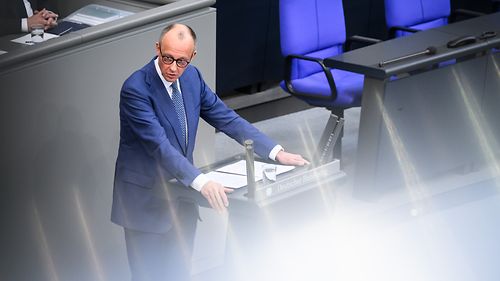
Europe’s ability to act sovereignly in an increasingly complicated world is at stake. Chancellor Friedrich Merz used his government statement before the German Bundestag to make a clear plea: Europe must not become a plaything of other powers.
Merz spoke on the occasion of the upcoming European Council and emphasized the necessity of regaining lost room for maneuver. “Where we can no longer act freely, freedom is lost,” the chancellor said according to a Tagesschau report. This statement formed the core of his foreign policy keynote address.
The chancellor began his statement unusually personally. He thanked Bundestag President Julia Klöckner for her speech on “Day of Democracy History” on March 18 and praised Federal President Frank-Walter Steinmeier as the initiator of the memorial day. With this, Merz placed the values of freedom, rule of law, and democracy at the center from the outset – values that, in his view, are endangered by a lack of capacity to act.
Specifically, Merz called for a consistent reduction of bureaucracy in the EU. Only in this way, he argued, could Europe remain competitive and conclude new free trade agreements. The federal government wants to resolve blockades and regain leeway that has been lost in recent years. According to Tagesschau, Merz pointed to “sensitivities” in society that have led to these restrictions.
In terms of foreign policy, the government statement addressed two crisis hotspots: the war in Ukraine and the Iran-Middle East conflict. Merz emphasized European solidarity with Ukraine and the necessity of united action against destabilizing actors. Europe must act together to be heard in Washington, Moscow, and other capitals.
The speech marks a shift in tone. While previous government statements often dealt with technical EU agenda items, Merz placed fundamental questions of European sovereignty at the forefront. His interim conclusion, according to Tagesschau: Europe’s ability to act is the most important guarantee for preserving its own freedoms.
This practically means a dual strategy for Germany. On one hand, Berlin must push for deregulation and more flexible trade policies in Brussels. On the other hand, it is crucial to forge alliances within the EU for a stronger foreign policy role. Merz is thereby sending signals to both European partners and transatlantic allies.
Reactions in the Bundestag remained restrained. The opposition criticized that the announcements remained vague. Yet, Merz set a marker with his speech: In a world of growing geopolitical tensions, Europe cannot limit itself to the role of an observer. The coming months will show whether words are followed by actions – for instance, in concrete EU reforms or negotiations over new trade agreements.
For citizens in Germany and Europe, this debate has direct consequences. From the competitiveness of the economy to the security situation and the ability to shape global issues, much depends on whether Europe remains capable of action. Merz makes it clear: This is not a technical EU question, but an existential one for the continent.
Where we can no longer act freely, freedom is lost
Auftretens — Tagesschau