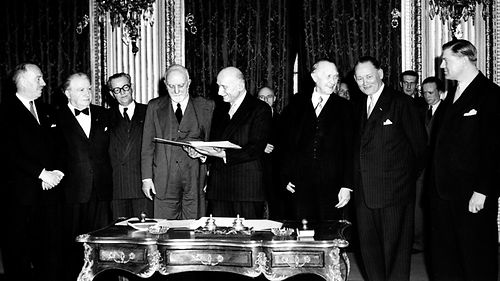
As the German Federal Government reports, the founding of the Montanunion is currently marking its 75th anniversary. The European Coal and Steel Community (ECSC), as the Montanunion is officially called, was established in 1951 and is considered a crucial starting point for a new, united Europe. According to the German Federal Government, its legacy continues to this day – as a foundation for peace and cooperation and as the cornerstone of the later European Union (EU).
The Montanunion was founded by six founding members – Germany, France, Italy, and the Benelux countries. Its goal was to place the coal and steel industries, which were considered key war industries at the time, under common supervision. This was intended to prevent individual countries from using these resources for military purposes. As the German Federal Government states, this step in 1951 marked the beginning of closer economic and political integration in Europe.
The founding of the Montanunion is now regarded as a milestone in European history. It laid the groundwork for further integration steps, which eventually led to the establishment of the European Economic Community (EEC) and later the European Union. According to the German Federal Government, the Montanunion was not only an economic project but above all a peace project. Through the joint control over coal and steel, conflicts between European nations, which had often led to wars in the past, were to be avoided.
The significance of the Montanunion for peace in Europe is also highlighted in current debates. As the German Federal Government reports, the anniversary shows that only a united Europe can secure peace. The common institutions and regulations that began with the Montanunion have helped build stable relations between European states and resolve conflicts peacefully.
The Montanunion itself existed until 2002, when its treaty expired. However, its structures and principles were incorporated into later European treaties. The European Commission, the European Parliament, and the European Court of Justice have their roots partly in the institutions of the Montanunion. Thus, its legacy continues into the present.
The anniversary of the Montanunion is being used to recall the beginnings of European integration and emphasize its importance for peace. As the German Federal Government states, European unification is an ongoing process that builds on the foundations of the Montanunion. The current challenges in Europe – from economic issues to security concerns – show how important cooperation and unity on the continent remain.
The Montanunion thus stands not only for a historical moment but also for an enduring commitment. Its legacy as a foundation for peace and cooperation remains a guiding principle for Europe's future.