As Green health politician Janosch Dahmen said on Frühstart on RTL and ntv, alongside the coalition the Greens also voted for the law, while the AfD and the Left abstained. The aim of the reform is that people in acute medical emergencies will in future receive fast, high-quality care everywhere in Germany – regardless of where they live. Its core elements are the interconnection of the emergency numbers 112 and 116117 and the establishment of Integrated Emergency Centres (INZ) at selected hospitals.
The reform is intended to relieve the burden on emergency departments and rescue services. According to the Federal Statistical Office, around 13 million outpatient emergencies were treated in German hospitals in 2024 – an increase of 5 per cent compared with the previous year and the highest figure since records began in 2018. That corresponds to an average of about 35,600 patients per day. A survey published on Tuesday by the German Society for Emergency Medicine shows that almost every second emergency department considers itself overloaded, in some cases so severely that patient safety can be at risk. 60.6 per cent of hospitals cited as a reason that patients could not be transferred to regular wards because there were no free beds there. Almost two thirds of hospitals reported unfilled posts in emergency departments in the medical service or in nursing.
How the reform is meant to work in practice
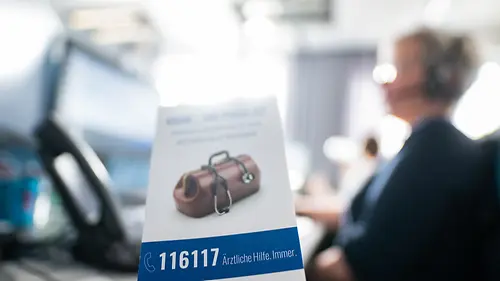
In future, the rescue control centres (112) and the control centres of the Association of Statutory Health Insurance Physicians (116117) are to be digitally interconnected. Whichever number is dialled: a standardised initial assessment is to clarify how urgent the case is. For milder complaints, the caller can be transferred directly to the other service. Anyone who dials 116117 receives a professional initial assessment: is a visit to the family doctor on the next working day enough, is an out-of-hours practice sufficient, or does an ambulance need to come? In life-threatening emergencies, 112 remains the first choice and the procedure does not change.
In the Integrated Emergency Centres, the hospital’s emergency department, an out-of-hours practice of the Association of Statutory Health Insurance Physicians and a central initial assessment point work together. Anyone who arrives without a referral is first assessed there. Mild cases such as a flu-like infection or a small cut are directed to the out-of-hours practice, severe cases to the emergency department. More than 700 such centres are planned; the taz cites around 750. Additional centres are to be created for children and young people where there is particular need. The locations are to be determined within six months of the law coming into force. Patients who call 116117 beforehand are to be able to use a so-called fast lane and be treated more quickly if their urgency is the same.
Another new element is that emergency rescue is to be classified as a benefit in kind of statutory health insurance. Medical emergency management, on-site care and care during transport are to be recognised as part of medical treatment – until now only the pure transport costs have been covered. According to the draft law, the federal government expects estimated annual savings of just over 1.2 billion euros in the long term. The digitalisation of emergency rescue and the interconnection of the control centres will be funded over five years from the Infrastructure and Climate Neutrality Special Fund with a total of 225 million euros. The law is to enter into force in its essential parts in 2027.
Criticism from the Greens, physicians’ associations and rescue services
Green politician Dahmen welcomed the reform as a “major” and “good” reform, but warned: “In interaction with the austerity laws on health insurers that the coalition is currently passing, there must be great concern that the number of specialist appointments, but also family doctor appointments, will now decline even further in the near future.” He feared “that good approaches of this emergency reform could come to nothing – where patients depend on doctor’s appointments because these are becoming ever scarcer”.
The National Association of Statutory Health Insurance Physicians (KBV) warns of “new parallel structures”. The KBV board members Andreas Gassen, Stephan Hofmeister and Sibylle Steiner criticise that nationwide 24/7 services are “neither staffable nor financially feasible”. It is “a blatant contradiction to build up new and expensive parallel structures while at the same time cutting funding for outpatient care”. Rescue services such as the Red Cross and the Johanniter fear underfunding. Henriette Neumeyer, vice-head of the German Hospital Federation, told “Bild”: “Central demands of the hospitals remain unconsidered in the present draft law.” Among other things, there is a lack of sufficient funding for treatments in the emergency centres.
Health Minister Carsten Linnemann (CDU) called the law, according to morgenpost.de, a “emergency signpost for patients”: “Anyone who has an emergency should get help quickly. That is the central claim of our healthcare system.” Whether someone is an emergency will in future be decided professionally – on the phone via 116117 and in the emergency centres. A Forsa survey commissioned by the AOK Federal Association shows broad approval: 78 per cent of respondents support a standardised initial assessment procedure, 15 per cent reject it.
The reform of emergency care has been discussed for years. As early as 2019 there was an attempt that failed because of resistance from the federal states and later because of the coronavirus pandemic. The traffic-light coalition also had the reform on its list in autumn 2024, and the collapse of the coalition caused another postponement. The federal states remain responsible for the regional planning and organisation of rescue services. The federal government is pressing for better digital equipment: ambulances are to transmit patient data to clinics in a standardised way, and a system for displaying free hospital resources will become mandatory. In future, all rescue control centres are to guide callers through resuscitation on the phone and be interconnected with first-responder apps.
Earlier coverage: Bundestag votes on emergency care reform