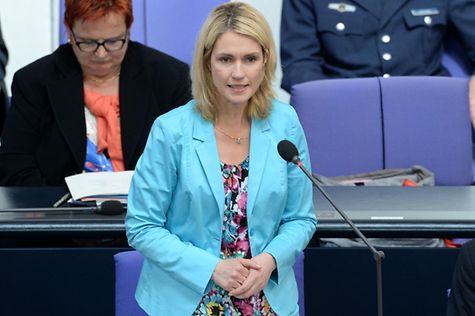
Under plans by Federal Family Minister Karin Prien (CDU), parental allowance is not to be cut to twelve months but will continue to be paid for up to 14 months. This emerges from a document of the Family Ministry that is exclusively available to the ARD capital studio, as tagesschau.de reported on Wednesday, 28 October. At the same time, the minimum and maximum rates are to rise for the first time since the benefit was introduced in 2007 – from 300 to 330 euros and from 1,800 to 1,900 euros, as the ministry announced according to Welt and Tagesspiegel. A corresponding draft law has gone into internal government consultation; nothing has therefore been decided yet.
In the summer, the ministry, under tough savings requirements, had still drawn up a draft that provided for a cut in the entitlement period from 14 to twelve months. In that draft, three months would have been reserved for each parent, and six further months could have been shared between the partners. If only one parent had taken parental leave, parental allowance would have been paid for a maximum of nine months. That plan had triggered public criticism.
Four months for the mother, four for the father
Now the division is to look different: four months each are firmly reserved for mother and father, and six further months they can freely share between themselves – the so-called 4-6-4 model. Single parents are still to receive parental allowance for up to 14 months. Both parents may again receive parental allowance simultaneously without limit; after the last reform, this was limited to one month within the child’s first year of life.
For the income replacement rate, the ministry plans a differentiation: in the reserved months, 80 per cent of previous net income is to be paid instead of the previous 65 per cent, and in all other months only 50 per cent. In the net calculation, Christmas bonus and other additional payments are also to be included in future, as Welt reports. The sibling bonus for families with other children in the household is to be paid for longer, and administrative effort is to fall so that the money reaches parents faster.
Prien told the news agency dpa that a good solution had been achieved in the coalition. “We have agreed to develop parental allowance structurally further and to adapt it better to the reality of life of young families today. In this way we ensure that starting a family remains attractive for young people in Germany in the future too.” She told the ARD capital studio that this was not a “role reversal”. What had convinced her above all were young families who had told her: “How are we supposed to manage that with the settling-in at the Kita?” On partnership, she explained: “We also wanted to give an incentive for more fathers to be prepared to get involved.”
Less savings than originally planned
The reform had also arisen because of the savings requirements for all ministries. “There will still be a savings effect, also with this model,” Prien said according to tagesschau.de – “it will be smaller than the original model”. For 2027 there is no difference, since less parental allowance will also be paid out because of the falling birth rate. From 2030 she plans savings of just under 1.3 billion euros with the new model, less than originally envisaged. This had been agreed with the Federal Ministry of Finance; all other budget questions would be discussed in the coming weeks.
Der Tagesspiegel points out that many families will not benefit from the higher minimum and maximum rates: those between the two amounts are subject to the replacement rate – and that falls from 65 to 50 per cent in the non-reserved months. According to the Federal Government, around seven billion euros in parental allowance were paid out in 2025, to 1.6 million recipients. In 2021 the figure was still more than 1.8 million. In 2024, 290,105 people received the maximum amount and 349,157 the minimum rate. Experts consider a reform overdue: because of the missing inflation adjustment, the benefit has lost around 38 per cent of its purchasing power since its introduction, according to a study by the Institut der deutschen Wirtschaft. When the reform is to come into force is still open.
Editor’s note: Whether the new model fulfils its claim of bringing more fathers into childcare can only be measured after the decision and the first years of receipt. So far only the draft from the ministry is certain – the internal government consultation is ongoing.