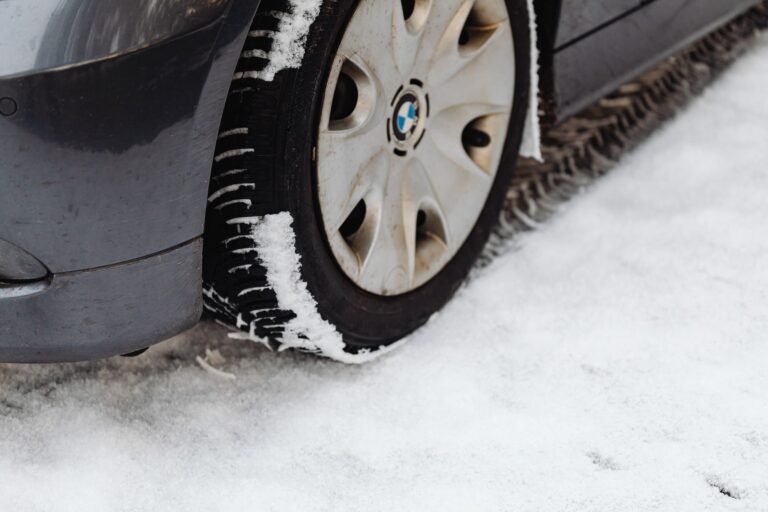
Anyone driving on snow or ice in Germany with summer tyres pays at least €60 and gets a point in Flensburg, even though there is no “October to Easter” rule. Only the weather counts. Workshops fill up from October, so it is worth checking your tyres now.
The legal basis is section 2(3a) of the Road Traffic Regulations (StVO): in “black ice, icy snow, slush, ice or frost”, motor vehicles may only be driven on tyres meeting section 36(4) of the vehicle licensing rules (StVZO). According to the motoring club ADAC, the “O to O” rule of thumb has no legal meaning. Exceptions include motorcycles and farm and forestry vehicles.
Which tyre counts as a winter tyre?
What matters is the Alpine symbol, a mountain pictogram with a snowflake. Since 1 October 2024 a plain “M+S” marking is no longer enough in winter conditions; the transition period for older tyres has expired. Such tyres may still be used on dry roads. All-season tyres count as winter tyres if they carry the Alpine symbol. ADAC says the duty is met when all four wheels have suitable tyres.
The law requires at least 1.6 millimetres of tread. ADAC recommends at least four millimetres in winter and replacing winter tyres after six years at most, as the rubber hardens. Below about 7°C winter tyres grip better than summer tyres.
What does a breach cost?
For drivers: €60 and one point; €80 if others are obstructed, €100 if they are endangered and €120 if there is an accident. The point is given per offence, not per tyre. Owners can be fined too: according to ADAC, €75 and a point. The €60 and €80 figures appear in the official fines catalogue; Stuttgarter Zeitung gives the higher tiers.
Insurance can hurt more: in cases of gross negligence, comprehensive insurers may cut their payout, and in a not-at-fault accident a driver can be assigned partial blame. Those on summer tyres must also stay at or below 50 km/h and check that the journey is necessary.
In practice, book the tyre change now, using an independent workshop nearby if needed. With a rental car you may refuse a vehicle on summer tyres in wintry conditions. Rules differ in Austria, Switzerland and South Tyrol, so check before travelling.
Sources: ADAC, ADAC Southern Bavaria, StVO, Stuttgarter Zeitung