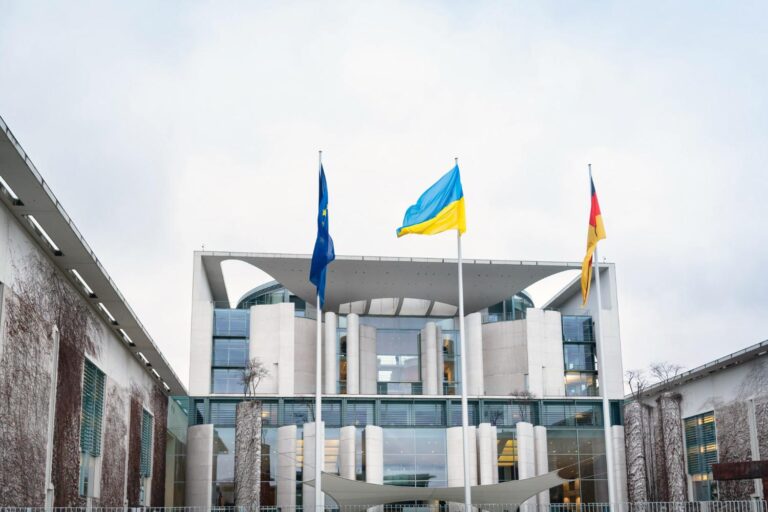
German Chancellor Friedrich Merz is hosting nearly 40 delegations this Thursday at the summit of the so-called “Coalition of the Willing” at the Federal Chancellery in Berlin. According to government sources, the delegations will arrive from 1 p.m., around 30 of them led by heads of state and government, as the Berliner Zeitung reports, citing government sources.
Ukrainian President Volodymyr Zelensky and the US negotiators Jared Kushner and Steve Witkoff are expected. According to the German government, representatives from a total of 37 countries are coming, supplemented by the leaders of the EU and NATO. The meeting is held under the motto “Together for peace in Ukraine and European security” and is organised in the E3 format together with France and the United Kingdom; Ukraine is also taking part in a prominent role.
First Kushner and Witkoff, then the round of heads of state and government
Merz will first receive Kushner and Witkoff, according to government sources. Talks with British Prime Minister Andy Burnham and French President Emmanuel Macron are then planned before the Chancellor meets with the remaining delegations. A joint press conference is scheduled for around 5.15 p.m., to be attended by Merz and Zelensky as well as Macron, Burnham, Kushner and Witkoff. According to Ukrinform, a separate meeting in the E3 format involving the Ukrainian President is also planned before the plenary session.
According to the German government, the agenda includes ways to a just and lasting peace, further support for Ukraine – politically, financially and militarily – and security guarantees for the country. The meeting serves to closely coordinate and support the partners for further direct talks between Russia and Ukraine with active participation of the US and Europeans in the so-called “Team Europe”, according to a paper from government sources obtained by ZDFheute. Following the latest negotiation meeting in Abu Dhabi, the aim is to coordinate the next steps.
According to ZDFheute, one of the summit’s messages is to be that the financing of Ukraine will succeed throughout 2027. In addition, readiness for negotiations should be signalled. Prisoner exchanges were agreed at the talks in Abu Dhabi. “That is good for the people who are released, but it is not the big breakthrough for the peace process,” said ZDF reporter Sebastian Ehm. Russia continues to reject an immediate ceasefire.
Wadephul: Without the US it will not work
Foreign Minister Johann Wadephul expects a substantial US involvement in security guarantees for Ukraine after the end of Russia’s war of aggression. “I believe that participation by the United States of America is necessary and also sensible, and that this is also a shared understanding for the future,” the CDU politician said on the sidelines of a visit to the Armenian capital Yerevan, as reported in the dpa dispatch on news.de. He was “firmly convinced that we will develop a shared understanding with the United States of America on how we can credibly implement these security guarantees”.
Peace negotiations only made sense “if everyone, and in particular the Ukraine that has been attacked, can assume that something like Russia’s attack will not happen again,” Wadephul continued. The security order in Europe was essentially embodied by NATO – “and as is well known, the US is part of that”. Asked whether he could imagine a continuation of the direct talks between Ukraine and Russia mediated by the US in Abu Dhabi at foreign minister level, Wadephul answered cautiously: the Chancellery represents the German government in these talks, and the Foreign Office is closely involved. It remained to be seen whether it would be necessary or sensible “at some point” to involve the foreign ministers. That was not his first concern.
Security guarantees only after a ceasefire
The dpa dispatch on news.de mentions around 35 member states and a founding by the United Kingdom and France in early 2025; according to the German government, there are almost 40 states.
The meeting is also to reaffirm the joint readiness for robust and legally binding security guarantees that are to enter into force after a ceasefire. According to the German government, this includes a “Multinational Force Ukraine”, among other things to support the regeneration of the Ukrainian armed forces. These guarantees are to be closely coordinated with the US. According to the German government, the EU heads of state and government agreed in Dublin on 13 November that the European negotiating team for peace in Ukraine would consist of representatives of the European institutions and the E5 – France, Germany, Italy, Poland and the United Kingdom.
In view of the approaching winter, the German government believes that above all Ukraine’s resilience must be strengthened – in military air defence as well as in civilian energy and winter aid. In the statement, Germany describes itself as the largest supporter of Ukraine.
On Friday, the day after the summit, the 9th German-Ukrainian Economic Forum will take place at the House of German Business in Berlin, organised by the Committee on Eastern European Economic Relations of German Business, the German Chamber of Industry and Commerce and the AHK Ukraine. Merz will give a speech at the opening; the focus will be on economic resilience, armaments cooperation, for example in drone production, and the reconstruction of Ukraine.