Ukraine has rejected as false the Russian report that the town of Dobropillia in Donetsk Oblast has been captured. The head of the Presidential Office, Kyrylo Budanov, said this on Tuesday, 20 October, while peace talks with US representatives were under way in Oslo, as the independent Ukrainian online outlet Hromadske reports.
According to the report, Budanov said that the commander of the Russian Centre force grouping, Colonel General Andrei Ivanaev, had falsely reported the capture of the town to President Vladimir Putin. Ivanaev was pressuring his subordinates to deliver a success after he had already announced the capture. “No false statements change reality,” Budanov said, according to Hromadske, and called on all sides to provide reliable information in the negotiations on a lasting peace. An independent verification of the competing claims was initially not possible.
One video, many questions
The dispute was triggered by a report from the Russian Chief of the General Staff, Valery Gerasimov, on 16 October. In a video conference with Putin, he spoke of captured territories and 92 settlements taken since 1 September – including Dobropillia and Velykomyhailivka in Dnipropetrovsk Oblast. For Zaporizhzhia Oblast, he reported the capture of the village of Malokaterynivka and an advance to within five kilometres of the regional centre. In Sumy Oblast, the Russian army claims to have destroyed Ukrainian units near Sadky, and in Kharkiv Oblast to have eliminated a “cauldron” with allegedly 2,000 Ukrainian soldiers in the north-east. According to BBC News Ukraine, Moscow provided no photographic or video evidence of the successes in the Ukrainian border area.
The Russian Ministry of Defence circulated videos in which soldiers show the Russian flag in buildings in Dobropillia. However, geolocation places the buildings in the south and east of the town, BBC News Ukraine reports. Some footage also bears traces of video editing with artificial intelligence. The commander of an assault platoon of the 61st Guards Brigade of the Russian Marines, Zakhar Tyshchenko, reportedly reported to Putin by video supposedly directly from Dobropillia – but according to the BBC he was in a very dark, apparently underground room with no discernible connection to the town.
“Dobropillia is our rear”
The 20th Brigade of the National Guard “Liubart”, which is responsible for this section of the front and belongs to the First Corps “Azov”, had the houses shown and geolocated in the Russian videos checked. Search and assault groups had found no enemy there, the brigade’s press officer, Lieutenant Colonel Mykhailo Butko (call sign “Daniia”), told BBC News Ukraine. There had not even been equipment or other traces. “As for the video of the Russian Ministry of Defence that went around the networks: our enemy has learned to wage hybrid war, they now master AI and montage editing,” Butko said. The enemy was “good at maximally deceiving his own compatriots with these videos”.
According to Butko, Dobropillia is currently Ukrainian rear territory along the contact line, with the fighting taking place in settlements in front of it. At the same time, he did not rule out that individual Russian groups had taken advantage of bad weather in recent days. Rain and fog impaired aerial reconnaissance. “In theory, the enemy can sneak in individually, I never rule that out. He can walk for four days, drink from a puddle, then a flag is handed to him, he shows it in front of the camera and dies.”
The press officer pointed to geography: within its administrative boundaries, Dobropillia is relatively small, but it lies in an agglomeration with neighbouring villages. Russian assault groups could have reached these settlements and then claimed a presence in Dobropillia itself. For infiltrations, they mostly used the same route via the settlement Rodynske and on via Svitly and Bilytske. They covered the ten kilometres on foot or with motorcycles and quad bikes across open terrain – easy targets for Ukrainian drones. The Ukrainian defence forces had also pre-emptively destroyed important logistics routes near Dobropillia in order to make mechanised assault attacks impossible. “That is why there are no mechanised assaults here, the Russians physically do not reach the target,” Butko said. Even with worse weather this autumn, Russia no longer had the personnel and material resources for a massive assault on the town.
Why the town matters so much
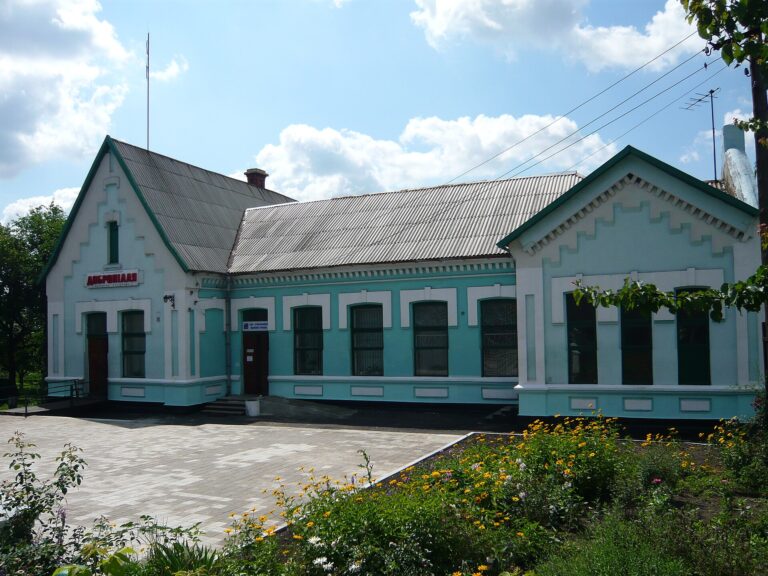
Dobropillia is considered the last and most heavily fortified place in the west of Donetsk Oblast. After the final fall of the neighbouring towns of Pokrovsk and Myrnohrad in spring 2026, the town became the main target of several Russian armies. From the flanks, a southern and a northern “pincer” were formed. According to the Russian command, the “encirclement” succeeded as early as late summer, after which assault troops entered the town from the south.
Dobropillia, the neighbouring Sviatohorivka and Hannivka form the last industrial agglomeration of the Donetsk region before the administrative border with Dnipropetrovsk Oblast. Sources in the Ukrainian military command told the BBC that an occupation of these places would be militarily valuable for Russia in addition to a media victory: the soldiers could entrench themselves in the town’s high-rise buildings and basements and gather personnel, and also deploy drones over Ukrainian routes on the town’s outskirts. If the agglomeration falls, the way into the neighbouring region opens up – the surrounding area consists of plains, fields and small villages.
President Volodymyr Zelensky had said on 18 October that the trend of this year continued: since the beginning of autumn, Ukrainian soldiers had liberated more territory than Russia had been able to capture. At the same time, he acknowledged cases in which Russians penetrate into the town – these would be destroyed “not easily, but”. Budanov stressed that objective information about the front was crucial, especially for difficult negotiations on a lasting peace.
Editor’s note: The accounts of both sides cannot currently be independently verified. The assessment that the Russian claims of success primarily serve the conduct of negotiations comes from Ukrainian sources and is identified as such.