If your work-related costs in 2026 exceed what the tax office allows as a flat rate, you normally get the money back only through your tax return, often a year later. A wage-tax allowance (Lohnsteuer-Freibetrag) brings it into your monthly pay instead. Two dates matter: for 2026 the application must reach the tax office by 30 November, and for 2027 you can apply from 1 November. Both come from section 39a of the Income Tax Act (EStG).
Is it worth it for you?
Not for everyone. The allowance is granted only if eligible expenses add up to more than €600 a year. Work-related costs count only above the €1,230 employee lump sum, and special expenses only above €36 (€72 for married couples and registered partners), as North Rhine-Westphalia’s tax administration explains. The €600 limit does not apply to, among other things, lump sums for disability and for surviving dependants, the single-parent supplement, household services and energy-efficiency work on an owner-occupied home.
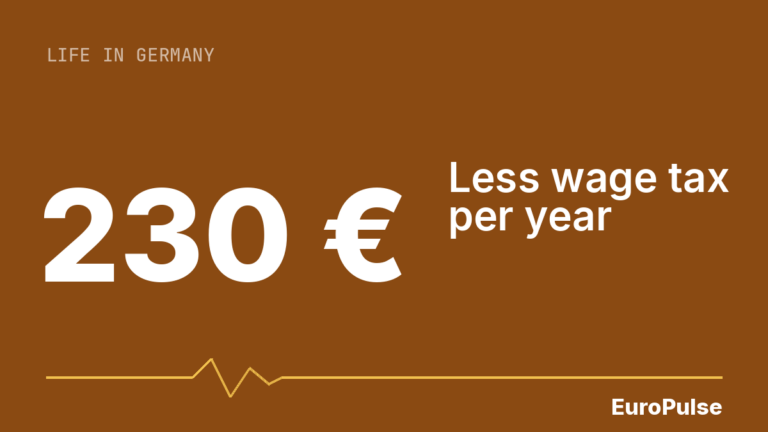
Typical candidates are long-distance commuters, people running two households, parents with childcare costs and single parents. A worked example by our editors: with €2,000 in work-related costs you are €770 above the lump sum. At a marginal tax rate of 30 per cent that is roughly €230 less wage tax a year, or just under €20 more net pay a month. It is a rough estimate, not a tax assessment.
One thing to keep in mind: the allowance does not create extra money, it only moves it forward. Whether you receive the relief in your December pay or next summer via your tax assessment, the sum is the same. And anyone who registers an allowance generally has to file a tax return as well. If the allowance was set too high, that return can end in a back payment.
How to apply, and when is it too late?
You apply with the form “Antrag auf Lohnsteuer-Ermäßigung” at the tax office for your place of residence, most easily online via ELSTER. That needs a one-off registration; the activation code arrives by post and can take up to two weeks. Depending on your expenses you add annexes, for example for children, work-related costs or special expenses. If you claim no more than last year and your circumstances have not changed materially, the simplified application is enough. Your employer then retrieves the approved allowance electronically.
The allowance is spread evenly over the months after you apply. An application at the end of November therefore brings relief only in the December 2026 payslip, and the tax return remains the main route. Apply in January 2027 and the allowance applies from 1 January. On request it can be fixed for two calendar years, so no application is needed in 2028.
Our view: for 2026 a last-minute application rarely pays off. It makes more sense to gather your receipts now and apply from 1 November for 2027, ideally for two years at once. Whether it adds up in your case is best checked with a Lohnsteuerhilfeverein or a tax adviser; the figures above are guideposts. A note on sources: one advice site gives 1 October as the start date, while the statute itself says 1 November – the statute is what counts.
Sources: Section 39a EStG, NRW tax administration, Steuertipps