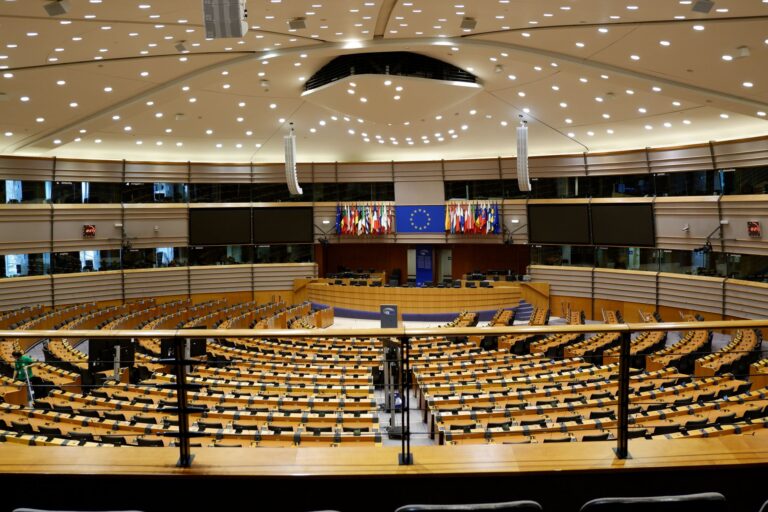
The heads of state and government of the European Union want to demand tougher sanctions against Russia at their summit this Thursday, openly going on the offensive against US President Donald Trump. That is reported by the news outlet Politico, citing a current draft of the joint final declaration. According to it, further punitive measures and steps against Moscow’s oil revenues are to be demanded in Brussels. The EU governments thus contradict Trump’s portrayal that he had achieved an energy ceasefire between Russia and Ukraine.
Polish Prime Minister Donald Tusk said on Monday at a security conference in Warsaw that Russia was “not interested in de-escalation, a truce or peace”. He would therefore travel to Brussels and call on his partners “to seriously consider expanding the sanctions against Russia”. German Chancellor Friedrich Merz also demanded further restrictions and pointed to the ongoing Russian attacks on Ukraine’s energy infrastructure despite Trump’s announcement of a ceasefire. “Russia will only negotiate seriously under pressure,” Merz said on Monday, according to Politico. After the “reckless attacks on Ukraine’s civilian energy supply”, the sanctions must “even be tightened further”.
The dispute reveals a growing rift between Washington and Europe. Only a few days ago, Trump concluded an agreement with Russian President Vladimir Putin that eases restrictions on Russian diesel exports. According to EU diplomats, this is to bring an additional 4.8 million tonnes of Russian diesel onto the world market in the coming months. However, European and Ukrainian officials doubt that this will noticeably lower fuel prices: the promised volume corresponds to only about ten days of US consumption, Politico quotes a senior EU representative as saying. A second EU official told the outlet, with a view to the US congressional elections next month: “This is about the midterms.”
Largest sanctions list, 23rd package in preparation
The EU had only decided on Monday the largest expansion of its Russia sanctions list since the start of the war. According to Politico, citing a senior Ukrainian official, the European Commission is also preparing a 23rd sanctions package, which is to be presented to the EU governments by the end of the year. The United Kingdom and Norway have also pledged to increase pressure on Moscow. “It is important to sanction Russia so that it does not finance the war,” Norwegian Defence Minister Tore O. Sandvik told the outlet, and called for closing loopholes in existing rules.
On Monday, the EU foreign ministers also called on the US to enforce its own sanctions. Republican Senator Lindsey Graham had pushed a comprehensive Russia sanctions law that Trump signed last month but has so far not fully implemented. EU foreign policy chief Kaja Kallas demanded that Washington coordinate its approach with Brussels. Republican Congressman Dan Crenshaw also spoke out in favour of implementing the law at the Warsaw conference.
Russia reports 320 billion dollars to the EU
Meanwhile, according to its own statements, the Russian government has supplied energy resources worth 320.7 billion dollars (around 287 billion euros) to EU states since 2022. As the Berliner Zeitung reports, citing the news agency Interfax, Deputy Prime Minister Alexander Novak gave the figure on Monday in an interview with the state television channel Rossiya 24; he referred to data from the Russian Energy Ministry. For the first nine months of this year alone, Novak put the deliveries at 21.3 billion dollars. According to the Berliner Zeitung, the figure cannot be independently verified: Novak did not break it down by energy source or by recipient country, and it remained unclear whether the period covers the whole of 2022. Continued imports also do not automatically mean a sanctions violation, since the EU bans took effect gradually and exceptions exist – for example for pipeline oil to Hungary and Slovakia. For LNG from long-term contracts, according to the European Commission, a transition period applies until the end of the year; from 1 January 2027, these imports will also be banned. According to the statistical office Eurostat, in the second quarter of this year 17.3 per cent of the EU’s LNG imports came from Russia, while the share for gaseous natural gas was 10.2 per cent.
According to the Russian business newspaper Vedomosti, Novak also stated that companies and energy ministries of both countries were already holding talks; Russia could increase its diesel exports to 3.5 million tonnes per month by the end of the year. This is a forecast by the Russian government, not a volume of deliveries already achieved. Republican US Senator Jerry Moran warned, according to Reuters, that allowing Russian diesel imports could weaken pressure on Moscow and damage the US’s credibility with its allies. Mark Temnycky of the Atlantic Council’s Eurasia Center pointed to the limited volume in an interview with Radio Free Europe/Radio Liberty: the 300,000 tonnes initially announced corresponded to about half a day of US consumption; he also doubted that Russia could deliver the promised volumes given the damage to its refineries.
Ukrainian drones and the shadow fleet
Military and economic pressure are interlinked. On 11 October, the Ukrainian military intelligence service DIU published data on 20 ships of the Russian shadow fleet that transport oil and gas. As the news agency Ukrinform reports, the authority stated on Telegram that all the ships were subject to sanctions by the United Kingdom or Ukraine, and one also to US restrictions. The tanker PORTOVYY was highlighted; it has belonged since 2021 to the sanctioned Gazprom group and served as a floating gas storage facility at the Portovaya complex in the Leningrad region. On 15 August 2026, the ship reportedly left the Gulf of Finland with a Russian LNG cargo for the first time since November 2021 and travelled via the Northern Sea Route to the Chinese port of Beihai. The DIU also names two gas tankers acquired in spring 2026 through shell companies, AVACHA and CHAIVO, which now sail under the Russian flag and bring gas to China. The authority called on foreign partners to control the sale of ships to Russia more strictly and to deny sanctioned ships the use of foreign shipyards.
The Austrian outlet orf.at already described on 6 October – that is, before the current summit – how effective the Ukrainian attacks on Russian refineries are, citing Reuters, the Kyiv Independent, TASS, OPEC and the analysis platform Kpler. At that time it was said that the Kremlin had lowered its oil production forecast to the lowest level in 17 years, Russia was increasingly importing fuel, and revenue from oil and gas in the first three quarters of 2026 had fallen by 17 per cent compared with the same period the previous year. These figures describe the situation at the beginning of October and are not a description of today.
Editorial assessment: The open dispute over Russian diesel shows how far the interests of Europe and the US have drifted apart. While Trump is focused in the short term on lower fuel prices before the congressional elections, the EU is concerned with the long-term source of funding for the Russian war machine. Whether the summit on Thursday produces more than a declaration also depends on whether Washington is prepared to actually apply its own sanctions, which have already been decided.