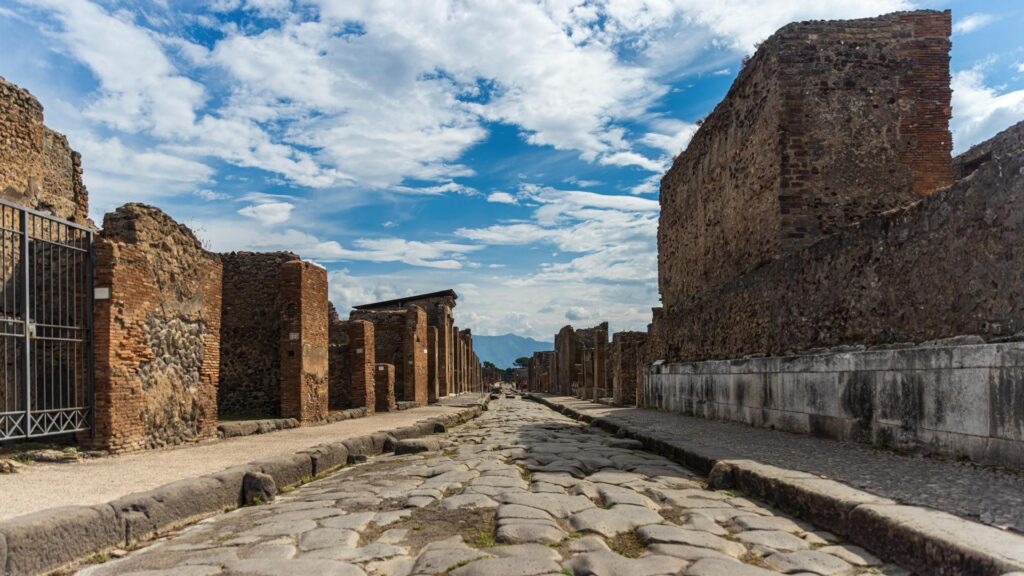
As Deutschlandfunk reports, Italian scientists have used artificial intelligence (AI) for the first time to reconstruct the appearance and final moments of a victim of the devastating eruption of Mount Vesuvius in 79 AD in Pompeii. The Archaeological Park published an AI-generated image showing a man running in a crouched position, holding a vessel over his head.
The reconstruction is based on the remains of a victim found during excavations in Pompeii. Using algorithms and machine learning, the researchers analyzed the body posture, bone structure, and surroundings to create as accurate a picture as possible of the person's final seconds. The result shows a man in a protective pose, apparently trying to shield himself from falling ash and glowing rocks.
The use of AI in archaeology is a relatively new approach that allows detailed information to be gleaned from fragmentary finds. Previously, reconstructions often relied on artistic interpretations or labor-intensive manual analyses. The Italian researchers used a combination of 3D scans, historical data, and AI models to simulate the victim's posture and appearance.
The publication of the image by the Pompeii Archaeological Park has attracted great interest among experts. Specialists emphasize that such reconstructions not only deepen understanding of the catastrophe but also provide an emotional connection to the fates of the people. The man in the image was likely a resident of Pompeii who, in his final moments, tried to protect himself with a vessel—a detail that underscores the drama of the situation.
The method could be applied to other finds in the future to reconstruct more victims of the Vesuvius eruption or other historical disasters. The researchers plan to publish their results in a scientific journal and further develop the AI technology to enable even more precise depictions.
The eruption of Vesuvius in 79 AD destroyed the Roman cities of Pompeii and Herculaneum, claiming thousands of lives. The layers of ash preserved many bodies in their final positions, later leaving casts that archaeologists have filled. The new AI reconstruction complements these traditional methods with a digital perspective.