Poland’s Prime Minister Donald Tusk has accused the national-conservative opposition PiS of an attack on democracy and the rule of law. “Let us call things by their name,” Tusk said in a televised address broadcast on Saturday evening, as reported by tagesschau.de and zdfheute.de. “For years there have been organisations and politicians in Poland who want to destroy democracy and the rule of law.” Tusk had previously remained silent throughout Saturday.
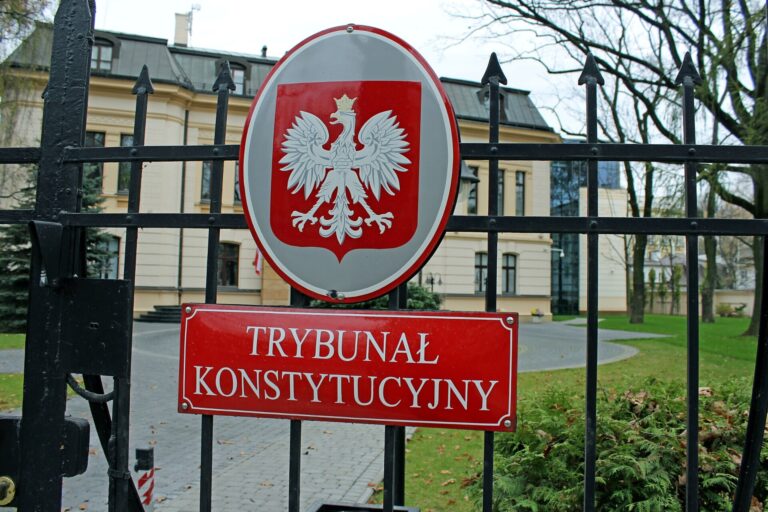
Specifically, the head of government referred to the appearance of President Karol Nawrocki in the cordoned-off Constitutional Court in Warsaw in the night to Saturday, 31 October. “The rule of law differs from the law of the jungle in that it is not muscles and insolence that decide who is right,” Tusk said according to zdfheute.de. “In a state governed by the rule of law, a judge, even if she is a petite woman, does not retreat before an aggressive thug.” No politician should enter the grounds of a court to issue instructions and intimidate judges.
In a video that Maciej Berek, the constitutional judge newly nominated by Tusk’s government, published on X, according to tagesspiegel.de, the former amateur boxer Nawrocki can be seen forcing his way into the building with robust physical force. According to Berek’s account, he also physically attacked Judge Anna Korwin-Piotrowska in the process. In another video, according to the report, Nawrocki says to her and several colleagues: “You are not constitutional judges!”
Talks in the Presidential Palace without result
In the early hours of Saturday morning, Nawrocki had declared to demonstrators that he saw the country’s internal security threatened, and convened urgent consultations of all parties represented in parliament for the same day “to stabilise the political situation and restore the constitutional order”. According to tagesspiegel.de, the statement was read out by his chief of staff Pawel Szefernaker. Nawrocki also demanded “the restoration of the legal order and the withdrawal of the security forces sent by the government from the court grounds”.
According to zdfheute.de, the meeting did not lead to concrete results. Defence Minister Wladyslaw Kosiniak-Kamysz of the Christian PSL and Szymon Holownia of Poland 2050 took part from the government camp. The parliamentary groups of Tusk’s Civic Coalition and the co-governing Left decided not to appear at the Presidential Palace; representatives of both groups pointed out that the purpose of the meeting had not been explained in more detail by the president.
How the escalation came about
The trigger was a notice on the Constitutional Court’s website: the previous president Bogdan Swieczkowski and his deputy Bartłomiej Sochański were relieved of their functions for one month, and Korwin-Piotrowska would head the court on an acting basis. Shortly afterwards, a post by the court on X denied the information and stated that the website had been attacked by hackers. According to srf.ch, Swieczkowski spoke of a “coup”.
On Friday evening, hundreds of demonstrators gathered in front of the court building in central Warsaw, most of them PiS supporters. The police cordoned off the building. As theguardian.com reports, the police arrested three people after some demonstrators overcame the court’s fence and threw objects at the officers. Nawrocki cut short his trip to Senegal and gained access to the court grounds during the night.
Korwin-Piotrowska is one of the five constitutional judges whom parliament nominated with the votes of the government majority and whom Nawrocki did not want to swear in. When the judges instead took their oath of office before parliament, the court president Swieczkowski, who was nominated during PiS times, refused them access to the building. On the TVP channel, according to tagesspiegel.de, Korwin-Piotrowska explained that Swieczkowski had made the court incapable of acting. As the most senior in service, she had therefore convened a meeting of all constitutional judges for 3 November.
The PiS governed from 2015 to 2023 and filled the court with judges politically close to it. The European Court of Human Rights classified this approach as unlawful in 2021. Since taking office in 2023, Tusk has been trying to reverse the controversial appointments; however, Nawrocki, to whose election in 2025 the PiS contributed significantly, is blocking the swearing-in of new judges. According to tagesspiegel.de, the European Court of Human Rights had already decided in May that these judges should take up their work.
Resignations and a divided country
The crisis is widening: Two of Poland’s ambassadors announced their resignation. “In view of the attempt to unlawfully take over the Constitutional Tribunal, I see no possibility of continuing to perform the function of Ambassador of the Republic of Poland in Romania,” Pawel Soloch wrote on X according to srf.ch. A few hours earlier, his counterpart in China, Jakub Kumoch, had declared on X that, given the events in Poland, he could no longer work as ambassador. According to the Polish news agency PAP, both diplomats were formerly staff of the then president Andrzej Duda.
As theguardian.com reports, Justice Minister Waldemar Żurek applied to strip Swieczkowski and Sochański of their immunity so that they could be prosecuted for obstructing the work of the court. The legal scholar Marcin Matczak, a pronounced PiS critic, told the newspaper that although he did not believe he would ever defend Swieczkowski, he considered the legal basis for his removal to be “non-existent”. The assessment of the lawfulness of the action is disputed among experts.
The conflict is likely to further polarise the country and run up to next year’s parliamentary election, in which polls give the populist right a chance of returning to power. For the people in Poland, the blockade above all means a paralysis of the judiciary and politics, as SRF’s Eastern Europe correspondent Peter Balzli writes in his short analysis – a stress test for the economically strongest EU country in Eastern Europe. Tusk himself had stressed on X that restoring the rule of law was his government’s duty: “After years of lawlessness under the PiS government, this is a difficult, sometimes painful process that requires determined action. There is no other way.”
Editor’s note: Whether the removal of Swieczkowski has legal validity is disputed among lawyers; 3 November and the announced meeting of all constitutional judges are likely to bring the next escalation.
Earlier coverage: Warsaw’s Constitutional Tribunal now has two bosses