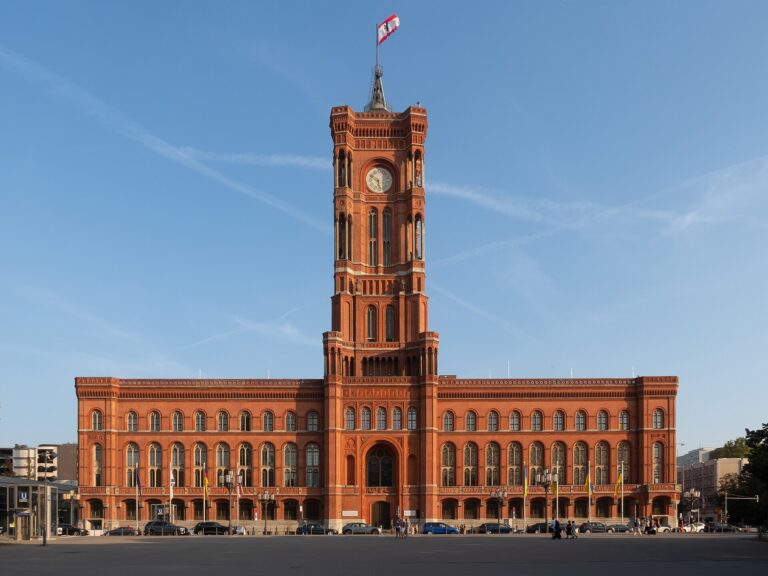
Berlin’s Left Party has voted at a state conference in Lichtenberg to open coalition negotiations with the Greens and the SPD. Both partners had already backed the talks, so the three could sit down as early as Monday. If a deal comes together, lead candidate Elif Eralp would become the capital’s first Left mayor (as of the evening of 31 October).
The starting point is unusual. In the 20 September election the Left became Berlin’s strongest party for the first time, with 25.7 per cent, up from 12.2 in 2023. The CDU took 18.8, the AfD 16.3 and the Greens 14.3. The SPD’s 12.1 per cent was its worst result in a Berlin state election; the FDP and BSW fell short of the five per cent threshold. The CDU–SPD coalition lost its majority, and every party in parliament rules out working with the AfD (Federal Agency for Civic Education, bpb).
What’s in the exploratory paper
The exploratory paper the three parties published on 17 October is unusually concrete. The biggest sticking point is socialisation: private landlords with at least 10,000 flats in Berlin would be expropriated against compensation, affecting about 160,000 flats owned by five companies. Compensation would be capped at €16 billion, financed by loans and recouped through rents. A bill is planned for mid-2028 and would take effect a year after passing.
Closer to everyday life: rent rises in the roughly 440,000 city-owned flats would be limited to two per cent a year, 100,000 building permits are promised by 2031, the Tempelhofer Feld stays unbuilt, and the social transport ticket (currently €27.50 a month) would get cheaper. The school ticket and school meals up to Year 6 stay free, mobile phones would be banned in primary schools, and 16 museum Sundays a year would be free again.
Where things could go wrong
The obstacles are plenty. Vonovia calls the plan unconstitutional and says it would not “survive judicial review”; it puts average rent in its Berlin portfolio at €8.26 per square metre. According to dpa, the CDU’s Thorsten Frei called socialisation the stupidest thing one could do. In July the federal government decided to block such transfers into common ownership, but no bill exists yet.
Politics is also uncertain. Twenty SPD members of the Bundestag oppose coalition talks “under current conditions”, citing recurring antisemitism rows in the Berlin Left. The parties therefore want a joint declaration against antisemitism written into the coalition agreement, with possible sanctions up to expulsion from the parliamentary group. Left MP Vanessa Emde, whose Middle East positions are disputed, no longer shares a working basis with the group leadership, they say. The youth wing Linksjugend Solid rejects the alliance, and about 80 people rallied outside the conference. Eralp told delegates: “I will not give up.”
Our assessment: a coalition agreement is likely, since all three parties have already approved talks. The real test is the socialisation law, where lawsuits are certain. A mayoral vote is realistically a winter event; that is an estimate, not a date.
Two points matter for Ukrainians in Berlin. Rent policy affects every tenant. And the parties want to pursue voting rights in local and state elections after five years of residence, as far as state powers reach. For now non-EU citizens cannot vote for the state parliament or district councils. Legally that is tricky: in 1990 the Federal Constitutional Court struck down similar laws in Hamburg and Schleswig-Holstein. Those who arrived in 2022 would reach five years only in 2027.
Sources: ZDFheute, bpb, Stuttgarter Zeitung (dpa), Volksstimme (dpa)