Germany will not participate in a military operation to secure shipping in the Strait of Hormuz. This was made clear by Chancellor Friedrich Merz in a government statement before the European Council, underscoring Germany’s rejection of a unilateral U.S. approach in the Middle East.
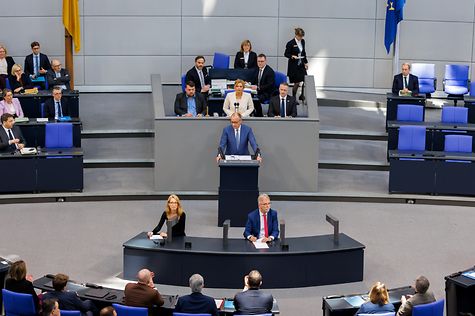
“Washington did not consult the Europeans. We would have advised against it,” Merz said on Wednesday in the Bundestag, as documented by the parliamentary archive. Such a mission lacks a clear plan and a mandate from the United Nations, the EU, or NATO. However, the chancellor emphasized that Germany will continue to work diplomatically toward a swift end to the war.
Merz directly attributes the current crisis in the region to the Iranian regime, which has broken international rules for decades. The German government shares the goal with the U.S. and Israel that Iran should no longer pose a threat in the future. At the same time, he expressed the hope that the Iranian people might bring about a legitimate government through democratic elections.
In addition to the Middle East conflict, Ukraine was at the center of the statement. Merz invoked the commonality of the USA and Europe for a just peace. A decision on the next sanctions package against Russia and the disbursement of a 90-billion-euro loan to Ukraine must come quickly. “I will emphatically advocate for this at the EU summit,” the chancellor announced.
The upcoming meeting of European heads of state and government is primarily intended to strengthen the EU’s competitiveness. Merz announced that he would advocate for reducing bureaucracy and less regulation in artificial intelligence. In terms of trade policy, it is about strengthening the single market and opening up new markets worldwide.
“Europeans must not sell themselves short,” Merz called for unity. The EU is dependent on others, but “others are also dependent on us.” This self-assertion is necessary in a world full of dilemmas, in which Germany and Europe must play an important role.
The opposition reacted with different emphases. Tino Chrupalla (AfD) demanded prioritizing security within German borders and consistently taking action against Islamism. Dirk Wiese (SPD) emphasized that in the current situation, a strong, cohesive EU is the crucial reassurance for Germany.
Katharina Dröge (Greens) criticized Merz’s handling of the special fund for security and climate protection as the “biggest mistake of his chancellorship so far.” She called for Taurus deliveries to Ukraine and accused the chancellor of remaining silent on international law during his conversation with US President Donald Trump.
Jens Spahn (CDU/CSU) stressed that the partnership with the USA and Israel does not mean “blind allegiance.” If the Iranian regime survives the war, it must be significantly weakened. Heidi Reichinnek (Left) condemned the US-Israeli attack as a violation of international law and demanded the closure of the US base in Ramstein.
The debate shows how much foreign policy issues polarize domestically. While Merz relies on European unity, opposition parties are calling for clear course corrections. The EU summit will reveal whether the chancellor succeeds with his line—and how Europe responds to the dual challenge posed by the conflicts in the Middle East and Ukraine.
so his interim conclusion is the most important guarantee,
Rande des Plenums — Tagesschau