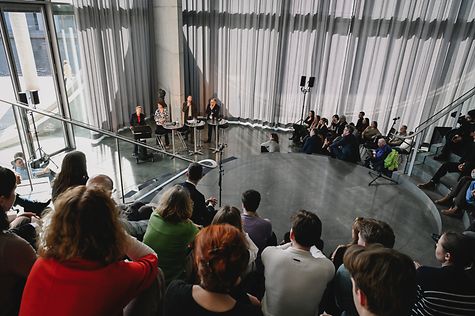
Germany’s democracy is facing significant pressures, but its demise is not a foregone conclusion. That was the consensus among leading academics during a panel discussion held in the Bundestag, timed to coincide with the nation’s first-ever Democracy History Day.
In the heart of German democracy, within the Marie-Elisabeth-Lüders-Haus of the parliament building, historian Sonja Levsen, political scientist Jens Hacke, and constitutional law expert Christoph Schönberger addressed a predominantly young audience. The central question: Is German democracy already a relic of the past, or does it have a future? The answers were nuanced, but far from apocalyptic.
Sonja Levsen from the University of Tübingen argued that societal change is an inherent part of democratic history. “Our democracy today is more open and participatory than it has ever been,” she stated, challenging the notion of a better past. She pointed out that new avenues for civic engagement are constantly emerging and that economic crises do not automatically lead to the collapse of democratic systems.
Jens Hacke of the University of Hamburg highlighted the adaptive capacity of liberal democracies. “The strength of liberal democracy lies in its ability to adapt and self-correct,” he explained. Historically, he noted, the greatest threat has not come from marginalized groups, but from elites who turn their backs on democratic principles—a danger that remains acute and demands more serious public discussion.
Christoph Schönberger from Heinrich Heine University Düsseldorf reminded attendees that democracy does not rest on rational argument alone. Parliaments, he said, also function through symbolic gestures and ceremonial acts. He cautioned against fixating on the old Federal Republic to understand the current state of democracy, suggesting that looking to neighbors like Italy reveals many perceived threats have unfolded there earlier.
The discussion was part of the “Forum W” event series and a key component of activities marking the inaugural Democracy History Day on March 18. This new commemorative day honors pivotal democratic moments in German history, from the Mainz Republic of 1793 to the first free parliamentary elections in East Germany in 1990.
Federal President Frank-Walter Steinmeier serves as the patron of this memorial day. While the scholars acknowledged that German democracy faces serious tremors, they agreed panic is unwarranted. The system has continually evolved and retains a fundamental capacity for renewal.
Our democracy is more open and participatory than it has ever been.
einem klaren Nein