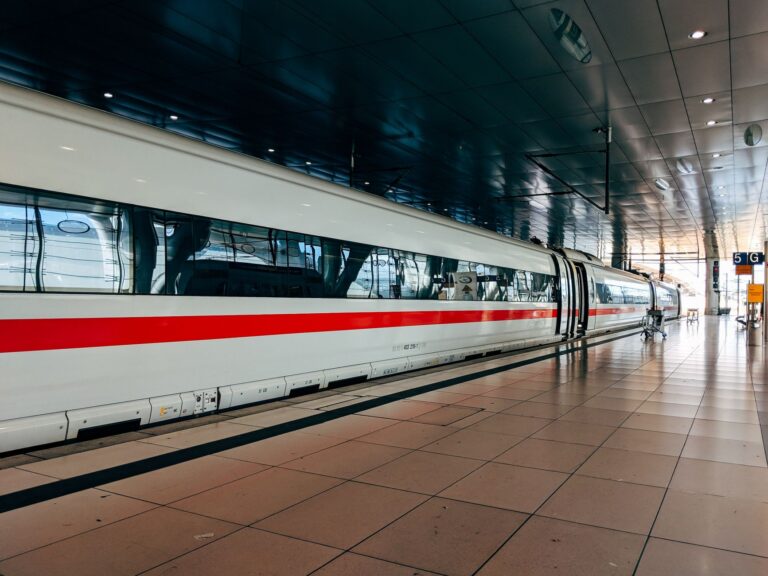
Deutsche Bahn does not have to free up capacity for competitors on heavily used routes for the time being. On Thursday, the Cologne Administrative Court declared a ruling by the Federal Network Agency dated 17 July unlawful in an expedited decision. The decision cannot be appealed. This means the rail infrastructure subsidiary DB InfraGo may not apply the so-called competition clause until further notice.
The Federal Network Agency had ordered that on highly congested corridors with designated capacity ceilings – such as at the Munich and Frankfurt nodes – DB InfraGo must in future allocate 25 to 40 per cent of train paths to providers other than Deutsche Bahn’s long-distance division. The trigger was a complaint by the Italian railway company Italo, which plans to enter German long-distance transport from 2028. The authority expected more competition to lead to lower ticket prices.
Why the court disagrees with the network agency
The judges based their decision on the fact that neither European law nor national railway regulation law provides for “an obligation on the operator of rail infrastructure to include a competitor clause in its terms of use”. In addition, the clause was unsuitable for achieving the purpose pursued with it. The Federal Network Agency still considers “such a regulation objectively necessary” in order to promote competition on the railways in the interests of passengers. However, it now does not have to enforce the clause until the matter is finally clarified in the main proceedings.
DB InfraGo welcomed the decision. A spokesperson said the aim of the lawsuit had been early legal certainty and fair allocation conditions for all. In the expedited proceedings, Deutsche Bahn had argued that the ruling would lead to significantly more conflicts over the use of certain train paths at certain times. This would create legal and practical problems for capacity management.
A setback for Italo and FlixTrain
For the competitors, the decision is a setback. Italo plans to operate in Germany from April 2028 with around 30 new Siemens high-speed trains. The company intends to invest around 3.6 billion euros, of which about three billion euros for 26 trains with an option for 14 more. Added to this are expenditure for hiring and training around 2,500 employees as well as investments in stations and IT infrastructure. “We want to offer passengers in Germany a greater choice, more frequent connections, fair prices and high-quality service,” said Italo chief Gianbattista La Rocca.
The market entry could be delayed by the expedited proceedings. Italo had hoped for long-term planning certainty. Flix, the largest existing competitor with its green trains, also does not benefit from the overturned regulation. Long-distance transport has so far been 95 per cent dominated by Deutsche Bahn. On the contested high-speed routes, the group says it earns the money with which it finances services in less sought-after regions. If lucrative train paths were given up, connections in the regions would have to be cut, Deutsche Bahn argues.
Several federal states share this concern. In a statement, Bavaria warned that regional transport could suffer if several companies competed for lucrative train paths. Brandenburg fears a reduction in services in the regions because cross-subsidisation of underused connections would fall away. The Railway and Transport Union EVG had also warned of the consequences. The association “Die Güterbahnen”, by contrast, criticised the lawsuit: “The infrastructure company is going to court to represent the interests of its sister company DB Fernverkehr and to further secure the de facto monopoly against new market entrants,” said its officer Oliver Smock.
The Federal Network Agency’s ruling was to take effect for the 2028 timetable year. The coalition agreement stipulates that more competition in long-distance transport should be ensured. How things will now proceed is open. The main proceedings are likely to take months. For travellers, this means no change to prices or connections for the time being. Whether Italo can maintain its start in spring 2028 also depends on whether the company receives planning certainty in time.