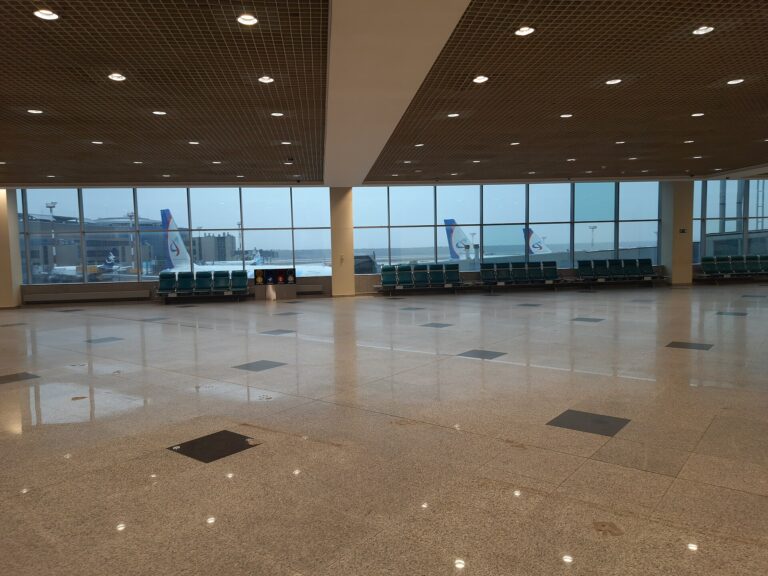
A large wave of Ukrainian combat drones struck the Moscow region overnight into Saturday, 10 October, severely disrupting air traffic at the Russian capital’s international airports. At Vnukovo, Sheremetyevo and Domodedovo airports there were numerous cancellations and more than 300 delays, as the English-language news portal Kyiv Post reported, citing the Ukrainian monitoring channel Exilenova+ and the Russian regional outlet MSK1. Moscow’s mayor Sergei Sobyanin stated that air defences had intercepted 403 drones aimed at the region between 20:30 local time on Friday and 8:30 on Saturday. The vast majority were destroyed on distant approach routes, and 25 were shot down in the immediate airspace in front of Moscow.
According to Kyiv Post, the Russian air transport authority Rosaviatsiya confirmed that the flight bans were lifted at 8:50 local time. Airlines had to adjust their schedules throughout Saturday morning to work off the accumulated delays. Figures on the number of affected flights differ: Exilenova+ cited around 300 cancelled or significantly delayed scheduled flights, while MSK1 cited at least 370 delays at the airports of the metropolitan region.
The disruptions are linked to a Ukrainian strategy of weakening Russian logistics and infrastructure. According to figures from the aviation security company Osprey Flight Solutions, which the broadcaster Euronews published in September, Russian airports temporarily suspended operations 993 times in August – an average of 32 closures per day. A total of 2,182 closures were recorded over the summer, more than in the whole of 2025. The investigative outlet The Insider calculated that the August figure is more than six times the monthly average of 2025. The trigger is the Russian air defence protocol “Kover” (Carpet), which holds or redirects civilian aircraft on the ground as soon as a drone threat is detected.
Why the airports become targets
Former Ukrainian defence minister Andriy Zahorodniuk told the news agency Ukrainska Pravda that the aim was not to shoot down civilian aircraft but to create lasting uncertainty. “Ukraine is not trying to shoot down civilian aircraft, but it is making Russian airspace unsafe for air traffic,” he said. Military expert Mykhailo Samus of the Centre for Army, Conversion and Disarmament Studies sees the airport closures as part of a strategy of economic exhaustion: rising insurance premiums, the withdrawal of foreign airlines and restricted domestic mobility. “Airport closures are the new reality for Russian aviation,” he told Euronews. Russia’s transport minister Andrei Nikitin had promised there would be no serious disruptions to civil air traffic – according to Euronews, operational data contradict this. In the first three days of September, an average of 86 flights per day were cancelled, as many as in the worst phases of August. On the Moscow–St Petersburg route, passenger numbers fell by 20 to 23 per cent, while demand for rail travel rose by around 20 per cent.
Attacks on refineries and data centres
The night of 10 October was not limited to the Moscow region. According to Kyiv Post, Ukrainian drones hit the Yug Rusi oil transshipment terminal in Rostov-on-Don and triggered a major fire there. According to these reports, the facility handles 2.5 million tonnes of petroleum products annually and also serves military supply. Already on Friday, 9 October, Ukrainian drones damaged a data centre of the Russian technology group Yandex in Kaluga, south-west of Moscow. Yandex confirmed that several hardware modules had failed completely and warned of disruptions to search, ride-hailing, cloud storage and enterprise services. The governor of the Kaluga region, Vladislav Shapsha, reported nine injured, five of them in hospital. According to Kyiv Post, another Yandex data centre in Sasovo in the Ryazan region had already been hit and completely shut down on Thursday, 8 October. The outages disrupted, among other things, the booking systems of Russian Railways (RZD), the mobile operator MegaFon and several media outlets. Yandex shares fell by around 4 per cent on the Moscow exchange.
The attacks are part of a series hitting Russian energy and digital infrastructure. On 5 October, according to the Ukrainian monitoring channel Exilenova Plus, Ukrainian drones hit the Volodarsk linear production and dispatch centre near Konstantinovo, the largest oil facility in the Moscow region. The independent Russian portal Astra reported that the facility produces 3 million tonnes of petroleum products annually; pipelines connect it to the region’s major airports. According to Ukraine’s defence ministry, more than 51 per cent of Russian refining capacity had been shut down by Ukrainian attacks by 4 October. These figures cannot be independently verified.
The Russian side continues to report civilian casualties in Ukraine as well. On 9 October, according to regional authorities, Russian glide bombs killed at least one person in Zaporizhzhia and injured seven others, including a child. Overnight into 6 October, debris from a downed drone struck a residential area in Kyiv’s Pecherskyi district, as a reporter on the scene reported.
Editor’s note: The statements of both parties to the conflict regarding drone operations and damage cannot be independently verified. The figures on intercepted drones and cancelled flights come from Russian authorities and civilian monitoring bodies; they cannot be cross-checked.