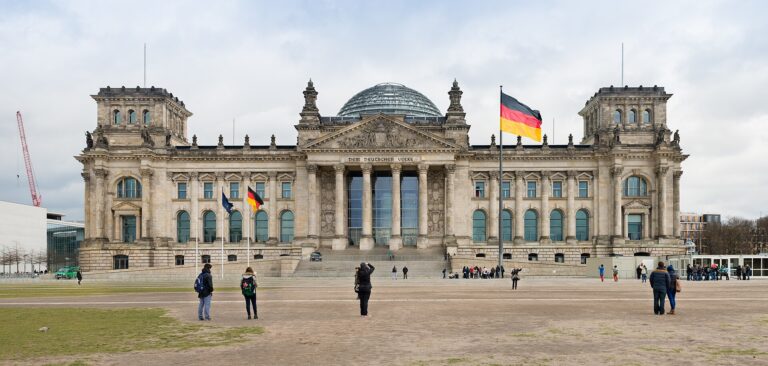
Federal Chancellor Friedrich Merz (CDU) will give a government statement in the German Bundestag early on Wednesday afternoon. On the same day, the world’s first criminal trial concerning the bombing of the Nord Stream pipelines in the Baltic Sea begins before the Hanseatic Higher Regional Court in Hamburg, as NDR reports. In Saxony-Anhalt, the AfD and BSW want to pass their first joint motion at a special session of the state parliament, calling for an immediate ceasefire and peace negotiations with Russia.
The trial in Hamburg is the provisional climax of the search for those responsible for the sabotage of 26 September 2022. According to the Federal Public Prosecutor’s Office, a total of seven people were directly involved in damaging three pipes of the Nord Stream 1 and Nord Stream 2 pipelines. They are alleged to have severely damaged the pipes at a depth of around 80 metres using explosive devices. The defendant is the Ukrainian Serhii K., a former member of the Ukrainian special forces, who is regarded as the head of the alleged sabotage team. According to NDR, the defence sees no “immediately incriminating evidence” of involvement in the act.
A trial with international attention
According to the Federal Public Prosecutor’s Office, Serhii K. boarded the sailing yacht “Andromeda” in the harbour of Wiek on Rügen no later than 8 September 2022 together with six accomplices; a middleman had chartered it for several weeks. According to the research network of NDR, WDR and Süddeutsche Zeitung, besides Serhii K. there was another soldier on board responsible for the explosives, plus a skipper and four civilian divers who had been cast in Ukraine. During dives, the group is alleged to have attached four explosive devices equipped with time fuses to the seabed. According to the court, the explosion caused damage in the mid three-digit million range.
The indictment accuses Serhii K. of a war crime, namely the use of prohibited methods of warfare through an attack against civilian objects. He is also accused of causing an explosive detonation, destroying structures and disrupting public facilities. The defendant was arrested at the end of August 2025 on the basis of a European arrest warrant on the Adriatic coast while on holiday with his family. He resisted his extradition but was transferred to Germany on 27 November 2025. One day later, an investigating judge at the Federal Court of Justice in Karlsruhe ordered the arrest warrant to be executed. The indictment was filed in early July 2026; the indictment document is said to comprise 108 pages.
Interest in the proceedings is high. According to the court, well over 100 media representatives have registered, including from Ukraine, Russia, the USA, the United Kingdom and France. The hearings will not take place in a regular courtroom but in the court’s special security wing. Court spokesperson Marayke Frantzen explains Hamburg’s jurisdiction by the fact that the gas pipelines come ashore in Mecklenburg-Vorpommern and that Hamburg has a contract with the state for hearing state security offences.
Why the trial is politically explosive
The Berliner Morgenpost sees the proceedings as explosive material for Federal Chancellor Merz. The CDU is clearly below 20 per cent nationwide, while the AfD is at almost 30 per cent. The AfD campaigns above all on high energy costs and advocates rebuilding the Nord Stream pipeline. In May, the Bundestag debated a motion by the AfD parliamentary group to set up a committee of inquiry into the attack; the other parliamentary groups rejected it. Political scientist and military expert Gustav Gressel told the Berliner Morgenpost that the AfD was driving the government ahead of it with the issue without offering viable solutions itself. The seemingly tempting cheap gas prices with the rebuilding of the pipeline were “an illusion”. Putin would not sell gas below the market price. “By restarting the gas pipelines in the Baltic Sea, Germany also makes itself blackmailable once again towards an autocratic regime in Moscow,” Gressel said.
The trial comes at a time when support for aid to Ukraine has been declining in surveys in recent years. Merz wants to stand firmly at Ukraine’s side, in line with the government’s position. Germany’s security would be defended in Kyiv. If the proceedings were to show that the highest state bodies in Ukraine had ordered or co-planned the attack, this could increase political pressure on the Chancellor.
Symbolic politics in Saxony-Anhalt
In Saxony-Anhalt, the AfD and BSW want to pass their first joint motion at a specially convened session of the state parliament. According to Spiegel, the draft motion states that the policy of sanctions against Russia as well as arms deliveries and financial aid have failed. The state government should advocate in the Bundesrat for an “immediate ceasefire and the start of peace negotiations with Russia”. According to Spiegel, the current government has so far left open whether it would consider itself bound by such a demand. The motion would have no consequences anyway: there is no majority for it in the Bundesrat, and the federal states are not responsible for foreign policy.
Spiegel classifies the special session as symbolic politics. In the night to Wednesday, according to Spiegel, Ukrainian President Volodymyr Zelenskyy reported heavy Russian attacks on his country; in Kyiv, an apartment block and a combined heat and power plant were hit. Once again, there had been no advance warning from the allies.
Editor’s note: The political assessment of the Hamburg proceedings and the motion in Saxony-Anhalt fall in a phase in which the government is under pressure anyway. Whether the trial actually shifts the debate on support for Ukraine depends on how the hearing proceeds.