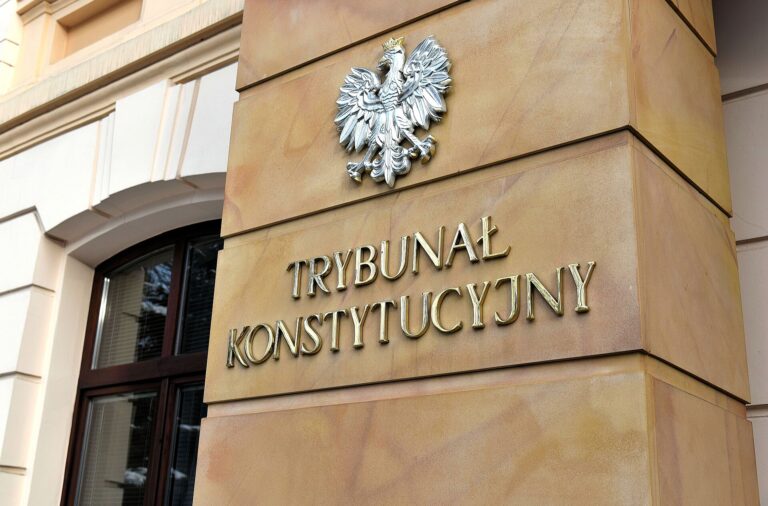
Two men who each claim to run the Constitutional Tribunal, a police cordon around the building and a president flying home overnight from a state visit: in Warsaw, years of wrangling over Poland’s highest court turned into an open test of strength in the early hours of Saturday. How it ends will help decide whether the country’s judiciary can function at all.
On Friday evening, 30 October, seven judges elected by the Sejm entered the Tribunal’s building accompanied by officers of the State Protection Service. Judge Anna Korwin-Piotrowska ordered the Tribunal’s president, Bogdan Święczkowski, and his deputy, Bartłomiej Sochański, suspended for a month and took over the leadership. The Tribunal itself said on X that its website had been unlawfully seized and that a “coup d’état” was under way, insisting Święczkowski remains president. Justice Minister and Prosecutor General Waldemar Żurek filed motions to lift the immunity of both men. Constitutional law scholar Marcin Matczak doubts that a justice minister can supervise the Tribunal at all.
Outside, police set up a cordon. According to Notes from Poland, Święczkowski’s supporters cut through the fence with a power tool; a Spanish outlet citing Reuters reports three people were detained. Opposition leader Jarosław Kaczyński told supporters: “As of today, Poland has become a police state.” Supreme Court First President Zbigniew Kapiński called it “undoubtedly a coup d’état”. Prime Minister Donald Tusk replied that restoring the rule of law is “our duty”, that the process is sometimes painful, and that “there is no other way”.
The president pushes his way in
President Karol Nawrocki cut short a trip to Senegal and arrived at the Tribunal after midnight. Footage shows him pushing past judges to get inside; Żurek spoke of an attack on the judges and said he expects prosecutors to act, while noting the president’s immunity. Nawrocki left around 5 a.m. His chief of staff, Paweł Szefernaker, read out a statement: a “breach of the constitutional order” and a “forcible takeover” of a constitutional body had occurred, and the security forces should leave the premises. The president summoned parliamentary groups to urgent consultations on Saturday.
Why now? The conflict has two roots. Under the Law and Justice (PiS) government of 2015–2023, the Tribunal was filled with loyal judges; the European Court of Human Rights found the process flawed in 2021, and the EU’s Court of Justice later denied the body’s independence and impartiality. Tusk’s coalition therefore partly refuses to recognise it and does not publish some of its rulings. Since March 2026 the Sejm has elected eight new judges, but Nawrocki, a PiS-aligned politician who won the 2025 runoff with 50.89 per cent, has sworn in only three. Five took their oath in parliament instead; Święczkowski barred them from the building. In May the ECtHR ordered, as an interim measure, that the judges be allowed to take up their posts. The president’s office rejected that, and Tribunal spokeswoman Weronika Ścibor said Strasbourg has no authority in the matter.
What happens next is open, and the following assessment is the newsroom’s, offered with caution. The likeliest outcome for now is two rival leaderships whose decisions are each challenged, leaving a court that was barely working before even more paralysed. Korwin-Piotrowska has called a session of all judges for 3 November, which will show how many follow her. A second path is a deal at Saturday’s consultations, for instance the five judges being sworn in against an end to coercive measures, though neither camp seems ready for that. The third, riskier path is further escalation through criminal proceedings, vetoes and bigger rallies this weekend, with the 2027 elections in view.
For Germany and Ukraine this is more than Warsaw’s domestic politics. Poland is a neighbour, a transit country for aid and one of the largest hosts of Ukrainian refugees, and clashes between government and president have already had concrete costs: in March Nawrocki vetoed a law meant to secure a €44 billion EU defence loan, as ZDFheute recalls. Brussels, which spent years pushing back against PiS’s interference with the courts, now has to decide how to respond to Tusk’s methods, even if his goal is a lawful one.
Sources: Euronews, Notes from Poland, ZDFheute, TVN24 (statement from the President’s Chancellery), Tagesschau