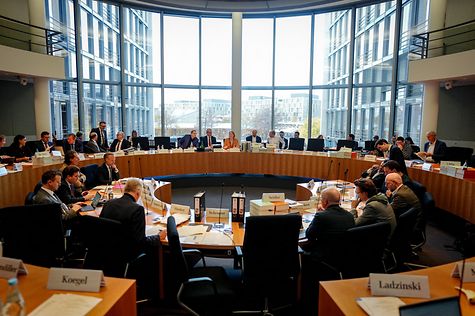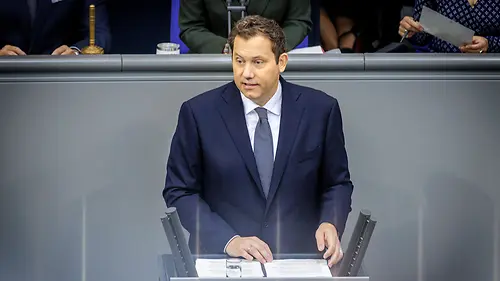
The Bundestag budget committee approved the 2027 federal budget in the night to Friday – with spending of around €560.9 billion and new debt of around €210 billion. As Bayerischer Rundfunk reports, the CDU/CSU and SPD voted for the draft after almost 16 hours of negotiations, while the Greens, the Left and the AfD voted against. The final vote in the Bundestag is scheduled for 27 November.
Spending is thus €5.5 billion above the first government draft and as high as never before in a single year. According to information from the reconciliation session, the core budget accounts for loans of almost €123 billion, plus €57.8 billion for infrastructure and €29.6 billion for the Bundeswehr from special funds. One in three euros in the budget plan is therefore debt-financed, as reported among others by “Freie Presse” and “Handelsblatt”. According to Deutsche Welle, it is the second-highest new borrowing in the Federal Republic – only 2021, during the Corona crisis, was higher at €215.4 billion.
€110 billion for the Bundeswehr, over €200 billion for social affairs
The defence budget is to grow to almost €110 billion in 2027, an increase of around €27 billion compared with the previous year, as Deutsche Welle reports. Added to this are expenditures from the Bundeswehr special fund. SPD budget expert Thorsten Rudolph said in Berlin that more than half of all debt would be spent on security and defence.
The largest single budget remains the Ministry of Labour and Social Affairs with over €200 billion. Above all, old-age provision drives costs: in 2025 the federal government paid out a good €420 billion in pensions, of which the state contributed €127 billion, according to DW. For 2027, subsidies from the Federal Employment Agency of more than €8 billion are planned.
Rudolph pointed to the pressure to consolidate: “We had a budget gap of €34 billion to close,” he said according to Tagesspiegel. “And it is clear that this government must not fail on a budget.” CDU budget official Christian Haase said the budget set priorities on “civil protection, military defence and transport and research investment” and supplemented them “with a strong welfare state”.
Dispute over electricity tax reaches Merz in Dublin
The cut in the electricity tax agreed in the coalition agreement remains open. The roughly €5.4 billion needed for it is not included in the draft. Federal Chancellor Friedrich Merz (CDU) said on the sidelines of an informal EU summit in Dublin: “I am sticking to my goal of lowering the electricity tax to the European minimum, starting next year and in full amount.” Finance Minister and SPD leader Lars Klingbeil showed himself open to the cut, but only with “serious counter-financing”.
The CSU deputy in the Bundestag, Oßer, said on Bayerischer Rundfunk that structural financing was missing; he rejected counter-financing through the abolition of the mothers’ pension as a question of justice. CDU budget politician Mathias Middelberg had warned on ZDF: “If you step out in public and promise the citizen something, then in the end you have to keep it. Otherwise I have full understanding if people are disappointed in us.” The coalition leaders want to discuss the question in the coalition committee on Tuesday; a compromise could still be introduced into the deliberations from 24 to 27 November.
The opposition sharply criticised the budget. Green budget official Sebastian Schäfer, according to “Freie Presse”, spoke of a “wooden shack without a foundation”, while Left budget official Dietmar Bartsch spoke of a “maze of debts, tricks and shifts”. AfD budget expert Michael Espendiller said the government was taking on “€400,000 in new debt every minute”.
The economic expert Monika Schnitzer criticised the prioritisation on ZDF: the mothers’ pension had already been decided, and now the money for the electricity tax cut was missing. More than two thirds of defence spending was currently financed through debt; if that continued for 15 years, the debt ratio would reach almost 100 percent. According to DW, it stood at 63.5 percent at the end of 2025. Germany is thus the only G7 country with a triple-A rating; around €42 billion will be due for interest in 2027.
As a reminder: our report on Thursday noted that housing benefit and the immediate child supplement would not be cut and that the electricity tax cut was missing from the draft. New are now the overall totals, the debt structure and the timetable up to the vote. After the 2027 budget, negotiations for 2028 begin – there, according to “Freie Presse”, a gap of around €25 billion again yawns.
Earlier coverage: Budget 2027: housing benefit stays, electricity tax cut dropped