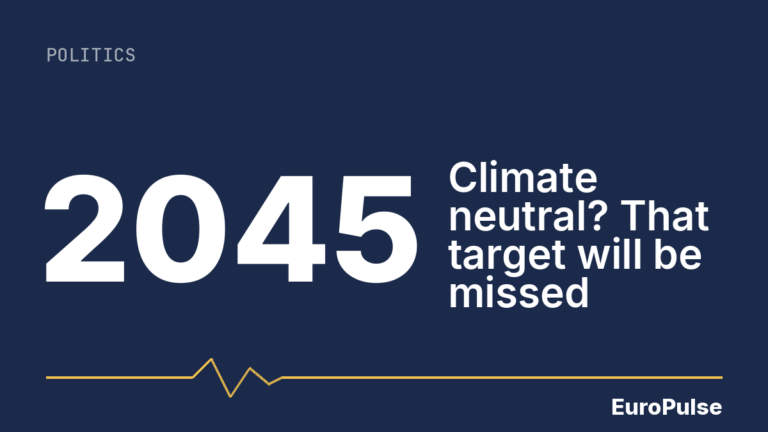
According to the Council of Experts on Climate Change, Germany will miss its legally binding climate targets – both the interim targets for 2030 and 2040 and climate neutrality in 2045. That is what tagesschau.de reported on Saturday, 14 November, drawing on the Council of Experts’ finding from May as well as current figures from the think tank Agora Energiewende. Environmental and nature conservation organisations accuse Federal Chancellor Friedrich Merz (CDU) and Economy Minister Katherina Reiche (CDU) of a rollback on climate protection.
The accusation carries weight because Merz himself had struck a different tone in the summer. In view of the devastating fire in Hürtgenwald in the Eifel, he said, according to tagesschau.de: “I want to tell all the climate change deniers: take a close look at what has happened here, this is climate change.” He and his government would do everything to push back climate change, Merz promised at the time. But according to the experts consulted by tagesschau.de, his policies do not follow that promise.
Staying away from COP and many individual measures
For the critics, the fact that climate protection is not at the top of Merz’s priority list is also shown by his absence from the climate summit. He justified the cancellation with, among other things, an important cabinet meeting. Climate campaigners were particularly outraged that Merz, who also had his birthday on Wednesday, wanted to go “nicely to the Italian” with his family. Otherwise, too, climate protection plays a barely perceptible role in the government’s actions, the report says.
“Unfortunately, I cannot yet see that he is doing everything to curb climate change,” says Niklas Höhne of the New Climate Institute. “Because there are very many things where the current government is doing exactly the opposite.” As examples, tagesschau.de cites the fuel discount, the German government’s fight in Brussels for the end of the combustion engine ban, the planned postponement of the methane regulation at European level – also at German pressure – and the Building Modernisation Act, which means that heating with oil and gas can continue even after 2045. Add to that the reorganisation of the Renewable Energy Sources Act (EEG), which is currently being debated in the Bundestag and could mean that the expansion of wind and solar energy soon stalls.
Berghülen shows where projects get stuck
The report describes how the lack of planning certainty affects things on the ground using the example of Berghülen, a town of 2,000 inhabitants on the Swabian Alb. There, the municipal council decided to build wind turbines as early as the late 1990s, and from the start citizens were able to invest financially. In 2012 an energy cooperative was founded, which has covered municipal roofs and an open area with solar panels. Today, on paper, the municipality produces almost six times as much green electricity as it consumes. An investor’s plans to build a large battery storage facility because of the electricity surplus have fallen through – too much bureaucracy, it is said. “The main problem I have heard from investors is that grid expansion is progressing slowly,” says Mayor Lukas Walter. And because the framework conditions of the EEG amendment are still not known, there is a lack of planning certainty.
Yet there is indeed an ambitious climate protection programme. Only in September, Federal Environment Minister Carsten Schneider (SPD) renewed Germany’s climate ambitions on the sidelines of the UN General Assembly and presented a roadmap for the gradual phase-out of coal, oil and gas. Germany is thus the third country worldwide, after France and the Netherlands, to present such a national plan. “Schneider doesn’t even have backing from Finance Minister Lars Klingbeil,” states Martin Kaiser of Greenpeace. “Unfortunately, Schneider cannot really prevail against Economy Minister Reiche,” says climate researcher Höhne. “And she currently finds more of a hearing with the Chancellor. That is why virtually all the measures that have currently been implemented are ones that increase emissions in the long term rather than reduce them.”
Little hope, but some signals
The black-red coalition, Kaiser says, must finally understand that climate protection is not a burden but an opportunity – “for example for the green tech sector, for the part of the economy that is currently posting growth figures”. That could also provide a counterweight to what Donald Trump is currently doing and lead to greater economic independence. Höhne points to possibilities such as consistent support for renewables or the use of the special fund for the urgently needed grid expansion and more batteries on the grid.
And the reality in Germany gives cause for hope in some places: the number of newly registered pure electric cars stood at 37 percent in October and was thus higher than the number of newly registered combustion vehicles. Höhne expects that from the beginning of next year more than half of newly registered passenger cars will be purely electric. Almost 80 percent of all new buildings are planned not with gas or oil but with a heat pump.
Already at the beginning of November, climate activists in Berlin had protested against the Chancellor’s cancellation of the COP31 World Climate Conference in Antalya. On the evening of 5 November, Fridays for Future projected huge images of the CDU leader onto a Bundestag building, with messages such as “Merzless climate summit” and “We’re showing Merz what the future is”, as the Tagesspiegel reported. “The fact that Merz is not going to the climate conference shows once again that he completely doesn’t care about the future of young people,” Fridays for Future said. The initiative announced further protests on 13 November in more than 70 locations across Germany.