A Russian reconnaissance drone entered Polish airspace over the border town of Dorohusk for several minutes on the night of Tuesday. The Polish Armed Forces General Command announced that the object had been tracked continuously by military radar systems throughout its flight. When the drone changed course towards the east, the decision was taken not to shoot it down in view of the safety of the civilian population. According to the news agency PAP, which learned from the Ministry of Defence, it was a reconnaissance drone equipped with cameras.
The incident occurred on Monday, 23 November, and thus only a few days after the crash of three Russian cruise missiles in Poland. According to the Polish journalist Przemek Sobusiuk, citing data from the Rynda Monitors map, the jet-powered drone flew near the Ukrainian border. Sobusiuk ironically spoke of a roughly 70-kilometre-long “walk” over Poland. Dorohusk is home to an important border crossing for freight transport and rail traffic towards Ukraine.
Only shortly beforehand, there had briefly been an air alert in parts of the Lublin administrative district. The government’s crisis centre called on residents of the border areas in the south-east of the country to seek shelter. Shortly afterwards, the alert was lifted again. The Polish military stressed that air defence remains on constant alert in order to respond to possible threats.
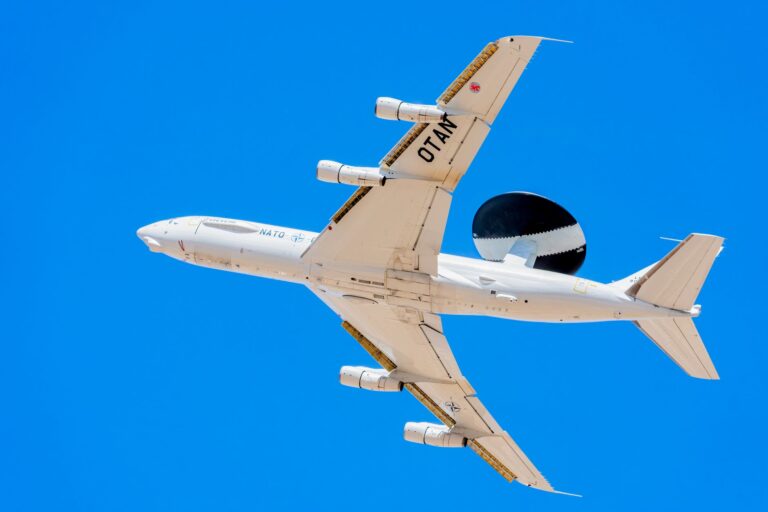
Nato deploys Awacs aircraft to Lithuania
On Monday evening, after consultations among representatives of the 32 alliance states in Brussels, Nato announced that it would strengthen airspace surveillance on the eastern flank. Nato’s Supreme Allied Commander Europe, General Alexus Grynkewich, had approved the deployment of an Awacs early warning aircraft to a forward location, alliance spokesperson Allison Hart announced. According to information from the German Press Agency from the alliance’s military headquarters in Mons, Belgium, this concerns the deployment of a reconnaissance aircraft to Lithuania. Grynkewich is also examining the deployment of further military capabilities, it was said.
The Awacs fleet consists of 14 aircraft and is actually stationed at Nato’s Geilenkirchen airbase near Aachen. With their mushroom-shaped radar structure, the aircraft can identify objects at a distance of more than 400 kilometres and pass the information on via data links almost in real time. Poland’s Defence Minister Wladyslaw Kosiniak-Kamysz wrote on X that the alliance’s early warning aircraft were already increasing the protection of Polish airspace.
The spokesperson stressed: “All allies stand unreservedly in solidarity at Poland’s side.” The violations of Polish airspace last week had been a dangerous incident for which Russia bore full responsibility. Already on Sunday, Nato Secretary General Mark Rutte had said during a visit to Warsaw: “Nato will defend every inch of Polish territory.”
Three Kh-101 cruise missiles
On Friday, 20 November, during massive Russian air strikes on Ukraine, three flying objects entered Polish airspace and crashed in the south-east of the country. No one was injured. According to the Polish public prosecutor’s office, all three cases involved Russian Kh-101 cruise missiles. According to information from the German Press Agency, they are said to have been manufactured in the fourth quarter of this year at an arms plant in Dubna, about 140 kilometres north of Moscow. Defence Minister Kosiniak-Kamysz had initially spoken of one Kh-101 missile, another suspected missile and “most probably” a jet-powered drone. The authorities reported search operations in the villages of Nowy Lipowiec, Molodycz and Rudnik.
Prime Minister Donald Tusk spoke of a “Russian provocation” and convened an emergency meeting of his government. He pointed to the coincidence with the first manoeuvre of the so-called coalition of the willing in Nowa Dęba in the same region. According to the “Presse”, 2,800 soldiers from eleven Western countries took part in the exercise led by the United Kingdom and France; it lasted until Sunday. The US Institute for the Study of War (ISW) also drew a connection to the manoeuvre in an analysis and wrote that the Kremlin had carried out the airspace violations at the same time as the exercise in order to undermine support for the coalition and test Nato’s reactions.
Warsaw announced that it would summon the Russian ambassador and turned to the Visegrád Group. “Russian aggression has crossed the border with Ukraine,” Tusk said according to PAP at a meeting of the group, which alongside Poland also includes Czechia, Slovakia and Hungary. The German Foreign Office stated on X that Russian flying objects had once again violated Polish airspace. “Instead of signalling a willingness to negotiate, Putin signals the opposite: he is relying on confrontation,” it continued. Germany stands firmly at the side of its neighbour and Nato ally.
The information on the course of the war comes from Ukrainian and Polish authorities and cannot be independently verified.