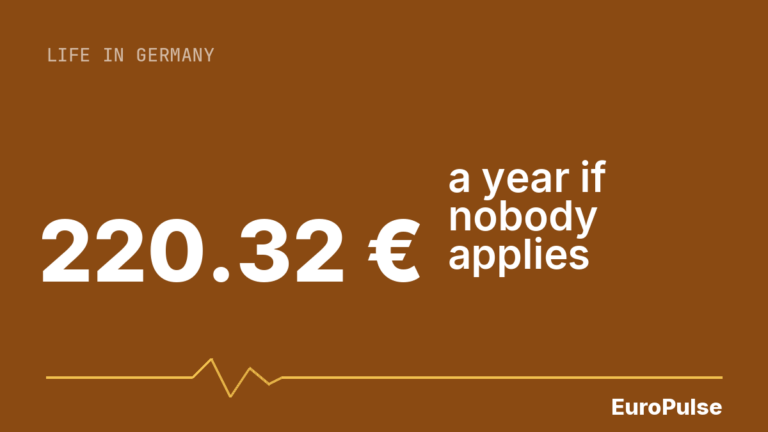
€18.36 a month, €220.32 a year: that is what the German broadcasting licence fee, the Rundfunkbeitrag, costs per household, however many people live in it. For people on welfare benefits it can usually be avoided, but only if they apply themselves. There is no automatic exemption: job centres and social offices do not report benefit recipients to the fee collector, the Beitragsservice.
For many Ukrainians the issue arrives with their first tenancy. Leave a shared refugee accommodation for a flat and, sooner or later, a letter arrives from Cologne. According to the Beitragsservice, anyone who does not reply is registered automatically and retroactively, with a bill running from the first month as the flat’s occupant.
Who can be exempted
The Beitragsservice lists several grounds, including Grundsicherungsgeld (the successor to Bürgergeld, renamed in mid-2026), social assistance, basic old-age and disability support, benefits under the Asylum Seekers Benefits Act, and BAföG or vocational training allowance for people not living with their parents. Which of these a Ukrainian family with protection under Section 24 of the Residence Act receives depends on when they arrived and which authority pays. For the exemption it makes no difference: both routes qualify.
Recipients of unemployment benefit I, housing benefit (Wohngeld) and transitional allowance have no entitlement. That surprises many, since incomes are tight there too. There is, however, a hardship clause: if income exceeds the needs threshold by less than one monthly fee, the Beitragsservice can exempt a person case by case. The Verbraucherzentrale and the Beitragsservice say the same applies if someone waives a benefit they are entitled to, in which case the award notice and a written waiver are required.
The exemption covers the whole household: spouses or registered partners and children up to 25 pay nothing extra. Other adult flatmates are covered only if their income and assets were taken into account when the benefit was granted.
How to apply, and what back-dating is worth
The form is completed online, printed, signed and posted to the Beitragsservice. Enclose a clear copy of your current benefit notice showing your name, the type of benefit and the period it covers, not the original. The nine-digit contribution number is on every letter from Cologne. The Verbraucherzentrale advises sending the application in a way you can prove, for example by registered post. The notice can be requested from the job centre or social office; do not apply without it.
The exemption starts in the month the notice shows the benefit beginning and ends when the notice does. For open-ended notices it is capped at three years, after which a new application is needed, and those who forget start paying again. Anyone who has never applied can have fees credited or refunded for up to three years back. At €18.36 that is theoretically up to about €660; the real figure depends on how far back the notices go.
People in shared accommodation, guesthouses or hotels used solely to house refugees do not have to register at all, according to the Beitragsservice. For your own flat registration is compulsory, but an exemption is still possible. Information is available in Ukrainian on the Beitragsservice website.
Our assessment: put the expiry date of your current benefit notice in your calendar. A lapsed exemption is the most common reason families suddenly receive payment reminders when nothing in their situation has changed. If your paying authority changed, or Bürgergeld became Grundsicherungsgeld, send the new notice to Cologne promptly; how the renaming affects individual cases we could not verify. The fee itself is not fixed either: gegen-hartz.de reports that the KEF recommends €18.64 from 2027, but an increase needs a new state treaty and remains open.
Sources: Beitragsservice: benefit recipients, Beitragsservice: application, Beitragsservice: refugees, Verbraucherzentrale, gegen-hartz.de