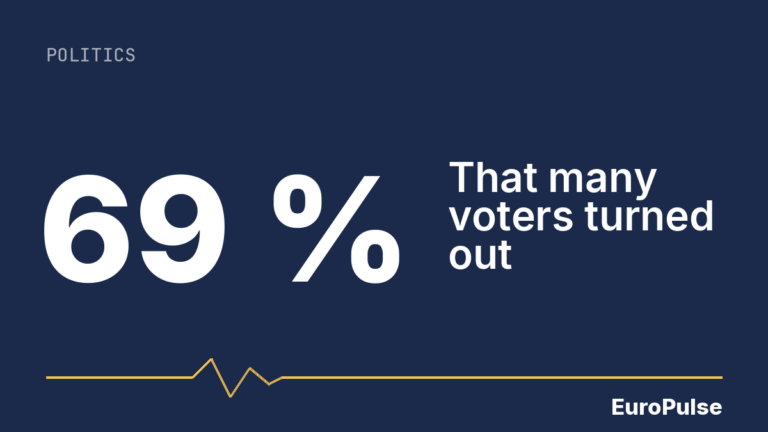
As tagesschau.de reported on Monday, the opposition student list took just over 52 per cent of the vote, while the governing Serbian Progressive Party (SNS) of long-time strongman Aleksandar Vučić took just over 39 per cent. Sunday's election thus saw a record turnout of 69 per cent.
Vučić had already conceded defeat on Sunday evening, before official results were available. “On the basis of a stratified sample, it is clear that we have lost this election,” he said according to the Berliner Morgenpost and Bayerischer Rundfunk, speaking to his supporters at the party headquarters in Belgrade. According to Bayerischer Rundfunk, Vučić said the student list would receive 135 to 140 of the 250 seats, and his own party 105. According to the election monitoring centre CeSID, the student list won 139 seats and the SNS 104, as t-online.de and orf.at report. The polling research group CRTA, according to Welt and orf.at, put the student list at 51.5 per cent and the SNS at 40.4 per cent.
Jubilation in Belgrade, dispute over the next prime minister
After the results became known, tens of thousands of people celebrated across the country. In Belgrade, car convoys raced honking through the streets, and according to t-online.de and the Berliner Morgenpost, tens of thousands celebrated exuberantly on the central Slavija Square. “Serbia is free,” the student list commented according to orf.at in a post on X immediately after Vučić’s appearance.
The movement’s list leader, the cardiologist Ilija Srdanović from Novi Sad, declared on election night that he was proud of his fellow citizens, who had hurled a clear “No” at the “tyrant” Vučić. “We are marching into a more civilised and better Serbia,” he said according to tagesschau.de and t-online.de. According to the reports, it is open who will become the new prime minister. Although Srdanović led the list, he is not automatically considered a candidate for the premiership; the movement has so far not committed itself on personnel matters. Among those mentioned as a possible minister is Dejan Šoškić, economics professor at the University of Belgrade and former head of the Serbian central bank. “Stability, peace and lawful conduct – that is now the most important thing in forming a new government,” he said in the evening according to tagesschau.de. There would be “no revanchism whatsoever and no revolution”.
The student list contains almost no students. It is carried by a movement without leadership bodies that takes its decisions in grassroots-democratic assemblies; the list is made up mainly of university lecturers, doctors and artists. Its concise eleven-point programme promises the restoration of the rule of law and democracy as well as the prosecution of corruption and crime.
A change of power with consequences for the EU course
The election was widely regarded as a referendum on Vučić, who has shaped Serbia since 2012 in changing roles. At the end of September, the 56-year-old resigned from the office of state president in order to become prime minister in the event of an election victory; his mandate would have expired in May next year, and after two terms he cannot run for this office again. According to tagesschau.de and t-online.de, for now only the role of opposition leader remains for him.
The movement had emerged from the protests after the collapse of a station canopy in Novi Sad. The reports differ on the timing: tagesschau.de and orf.at write of “two years ago” and 2024 respectively, while t-online.de and Welt name November 2024. Sixteen people died in the accident; critics attributed it to corruption and negligence by the government. Hundreds of thousands demonstrated in the aftermath and demanded new elections.
The change of power could also alter the country’s EU course. Serbia has been an EU accession candidate since 2012 and has been negotiating since 2014, most recently without progress. As the only European country apart from Belarus, Serbia did not adopt the EU sanctions against Russia after the attack on Ukraine in 2022. European Commission President Ursula von der Leyen and Council President António Costa congratulated the student list and wrote on X, according to tagesschau.de and t-online.de, that they were ready to support reforms in the rule of law, media freedom and the fight against corruption and to advance Serbia’s path into the EU. The Commissioner for Enlargement, Marta Kos, declared according to t-online.de: “The door to the EU is open, and we are ready to continue along this path together.”
Among the first to congratulate was Hungary’s Prime Minister Péter Magyar, who according to tagesschau.de and orf.at compared his own election victory against Viktor Orbán in April with the result in Serbia. Montenegro’s Prime Minister Milojko Spajić also congratulated; “a new chapter is being opened” in relations, he wrote according to orf.at on X. The movement has so far not commented in detail on its foreign policy course. Srdanović told the Montenegrin daily “Vijesti”, according to t-online.de, that the citizens first had to free themselves from Vučić’s “mafia state”; after that, an open debate about strategic goals would be possible.
The election did not pass without incidents. The polling research group CRTA reported, according to Welt and orf.at, numerous indications of vote buying and voter intimidation; ballot papers were photographed in 48 per cent of polling stations. Bayerischer Rundfunk, by contrast, names 25 per cent of all Serbian polling stations and half of all Belgrade polling stations. The Berliner Morgenpost also reports a suspected attack by around 30 unknown persons on a polling station in the southern Serbian city of Niš and two journalists pelted with stones in northern Serbia. Official final results were not initially available.