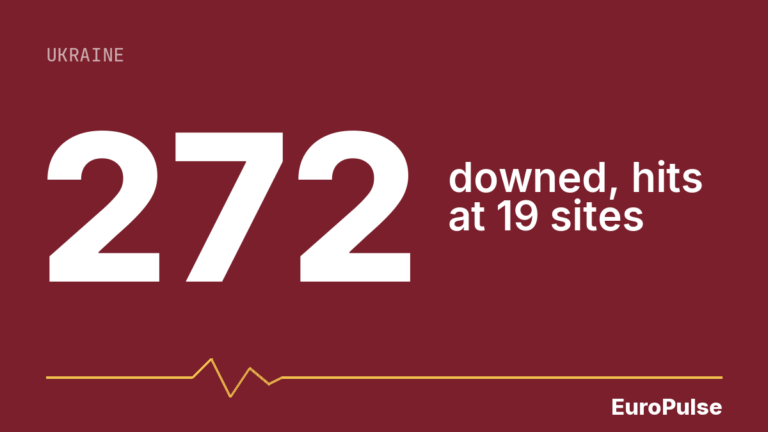
With 310 drones, Russia attacked targets across Ukraine in the night to Wednesday; according to its own account, the Ukrainian air force shot down or neutralised 272 of them. The air force announced this on Wednesday, 4 November, at 8 a.m., as reported by the Kyiv Post and n-tv, among others. According to sources, the attack began on Tuesday evening and included, besides Shahed drones – among them 81 with jet propulsion – also Gerbera drones and Parodiya decoy drones.
According to preliminary air force reports, Russian drones hit 19 locations, and debris from downed drones fell at 15 further sites. According to the General Staff, quoted by n-tv, more than 20 drones remained in Ukrainian airspace, and the defence was still ongoing in the morning. According to the Kyiv Post, anti-aircraft missile units, electronic warfare and unmanned systems units, and mobile fire teams were involved.
Odesa, Kovel, Rivne: where the drones struck
In Odesa, a shopping centre was hit on Tuesday evening. According to n-tv, local media report that it was the “Sim’ya” centre. The State Emergency Service (DSNS) confirmed the impact and stated that a large fire had broken out, which the emergency services were able to extinguish. “Despite repeated air raid alerts, the emergency services extinguished the fire immediately and prevented further spread,” the Kyiv Post quoted the DSNS as saying. According to initial official reports, there were no casualties. The head of the Odesa city administration added that the blast wave destroyed windows in neighbouring buildings.
In Kovel in the Volyn region, an attack on Tuesday damaged an infrastructure facility, and according to Mayor Ihor Chaika, large parts of the city were without power. The Kovelvodokanal water utility switched to emergency power, and the water supply ran until 11.15 p.m. on Tuesday. If the situation did not change, water was to be supplied on Wednesday from 6 to 9 a.m., Chaika wrote on Facebook. According to him, heating in the residential buildings continued to run.
In the Ternopil region, drones hit an energy facility, and according to the regional authorities, emergency services were deployed on site. In Rivne, explosions were heard around 4 a.m., as the regional governor, Oleksandr Koval, announced. Russian forces had tried to hit energy infrastructure; a private residential building burned in the Rivne district, and according to Koval there were no injuries. In Dnipro, Russian forces struck an industrial site, two men aged 38 and 57 were injured by shrapnel and taken to hospital in moderate condition, and a fire broke out.
Already on Tuesday evening, according to the Zhytomyr city council, Russia had attacked the city’s energy infrastructure. The council announced that if the power supply were not restored by morning, “invincibility points” would open throughout the community from 9 a.m. on Wednesday – emergency centres where people can warm up, charge their phones and go online.
Attacks shortly before new negotiations
The new wave comes at a delicate stage. According to the Kyiv Post, further talks between Ukraine, Russia and the USA are scheduled in Abu Dhabi on 10 and 11 November. President Volodymyr Zelensky is calling for a ceasefire, which should also include an end to attacks on energy infrastructure, as a first step towards a comprehensive solution. On Tuesday in Berlin, Zelensky said that a ceasefire could be implemented even without a direct meeting of the Ukrainian and Russian leadership. At the same time, he warned that continued Russian attacks were undermining the prospects for serious negotiations.
Ukraine has been urging its Western partners for months to supply air defence systems and interceptor missiles more quickly – also in view of the increasing attacks on the power grid. In the editorial team’s assessment, the night to Wednesday shows how closely military pressure and diplomacy are now interlinked: every new wave of attacks weakens the position of those who want to negotiate a ceasefire in Abu Dhabi.
The attacks on Tuesday and in the night to Wednesday are part of a larger campaign. According to an analysis by the Institute for the Study of War (ISW), reported by n-tv, Russia had targeted more than 20 energy facilities since the night from Monday to Tuesday and during Tuesday, causing major damage and power outages. According to the news outlet NV, the grid operator Ukrenergo described the attack as one of the largest on Ukrainian energy infrastructure since the start of the war; within 24 hours there had been more than 20 concentrated attacks with an “unprecedented amount of attack weapons”, which is why emergency shutdowns became necessary in several regions – including Kyiv and the Kyiv region. The attacks coincide with the start of the heating season.
Russia’s Ministry of Defence reported on Telegram that two power plants in the Kyiv and Zhytomyr regions had been hit, and that a cargo ship had been attacked near the port city of Odesa. These claims cannot be independently verified. On the Crimean peninsula, annexed by Russia, there were power outages after an accident, as n-tv reports.