Ukraine’s President Volodymyr Zelensky signed on Monday the laws extending martial law and general mobilisation – both now run until 29 January 2027, after 28 January had originally been envisaged. According to the Kyiv Post, citing the news agency Ukrinform, the laws numbered 5029-IX (martial law) and 5030-IX (mobilisation) take effect on 31 October, when the current extension expires.
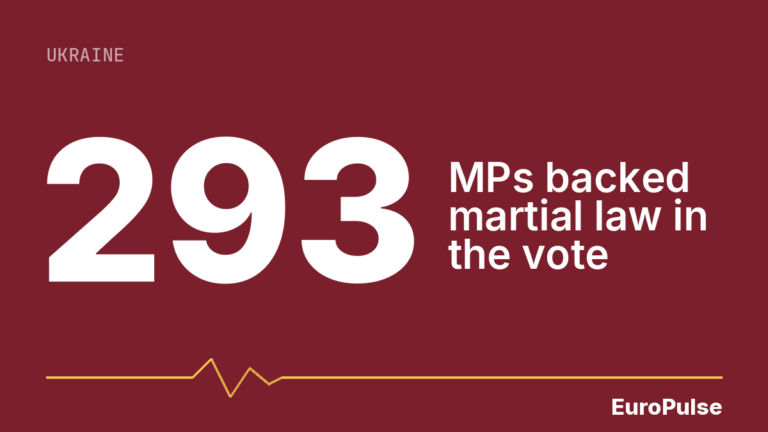
The signature came on the same day as the parliamentary vote. According to the news outlet Hromadske, 293 MPs voted for the extension of martial law, one against; 281 MPs voted for the mobilisation. The Committee on National Security, Defence and Intelligence had previously approved both bills, the Kyiv Post writes.
With the laws, parliament confirms two presidential decrees: No. 1060/2026 on martial law and No. 1061/2026 on general mobilisation. According to the Kyiv Post, the martial law decree cites Russia’s ongoing large-scale armed aggression as the justification and was issued on the proposal of the National Security and Defence Council. It amends Article 1 of Decree No. 64/2022 of 24 February 2022, which first introduced martial law nationwide.
“Adequate measures against the armed aggression”
Before the vote, the secretary of the National Security and Defence Council, Ihor Klymenko, told parliament, according to the Kyiv Post, that the extension helped Ukraine take “adequate measures against the armed aggression”. It also safeguarded the country’s independence, sovereignty and territorial integrity. According to Klymenko, the special powers of state bodies, military command, military administrations and local authorities needed to repel the invasion also remain in force.
Hromadske lists what martial law means in practice: the authorities may restrict the freedom of movement of citizens, foreigners and stateless persons as well as traffic, order labour duty, community service or the compulsory expropriation of private property, and convert institutions of all forms of ownership to defence needs. A ban on certain parties or associations working against Ukraine’s independence is also possible, as are restrictions on assemblies and demonstrations. The powers of parliament, government, courts and the ombudsman cannot be terminated during martial law, the constitution cannot be amended and no elections can be held.
The 21st resolution since February 2022
Martial law and general mobilisation have been in force in Ukraine since 24 February 2022, the start of the Russian invasion. Since then, according to the news outlet NV, they have been extended every 90 days under the procedure laid down by law – Monday’s vote was thus already the 21st extension of martial law. NV had reported before the session that the president had submitted the draft laws; MP Yaroslav Zhelezniak had expected the vote on Monday. The bills originally named 28 January 2027 as the end date; the laws now state 29 January.
Separately, according to the Kyiv Post, Zelensky also issued a decree on the defence of cities. The source does not give details.
Dispute over employee exemptions
The extension comes amid a debate about mobilisation itself. Only on 23 October, according to the Kyiv Post, the government of Prime Minister Serhii Koretskyi restructured the rules on exemptions for employees – automatic exceptions for arms and energy companies are thus expiring. Until now, most critical enterprises could exempt up to 50 per cent of their conscript-eligible employees, arms and energy companies up to 100 per cent. In future, full exemption will depend on a company supporting the army through a rotation scheme.
“An unconditional full exemption is unfair to those who serve and opens the door to abuse,” Koretskyi said, according to the Kyiv Post.
Some firms had been founded only to obtain exemptions, “that turned into a business”. The aim was that no one would have to look for anyone on the street any more – an allusion to recruiters detaining men in public. Arms manufacturers were already lobbying against the new rules and warned that even a cut in the quota to 85 per cent could stop production lines and delay weapons deliveries.
Without forward planning, Kyiv could again be forced into unpopular emergency decisions. In this context, the Kyiv Post recalls that Russia’s President Vladimir Putin increased the strength of the Russian armed forces to 2.4 million by Decree No. 700 on 28 September, including 1.5 million active soldiers – already the fourth such order in 2026.
Editor’s note: The extension until the end of January 2027 pushes the next decision into a phase in which the government is also tightening exemption practice. Together, the two are likely to increase pressure on enterprises and employees – how much depends on how the new quotas are applied in practice.
Earlier coverage: Ukraine’s Rada extends martial law until 29 January 2027