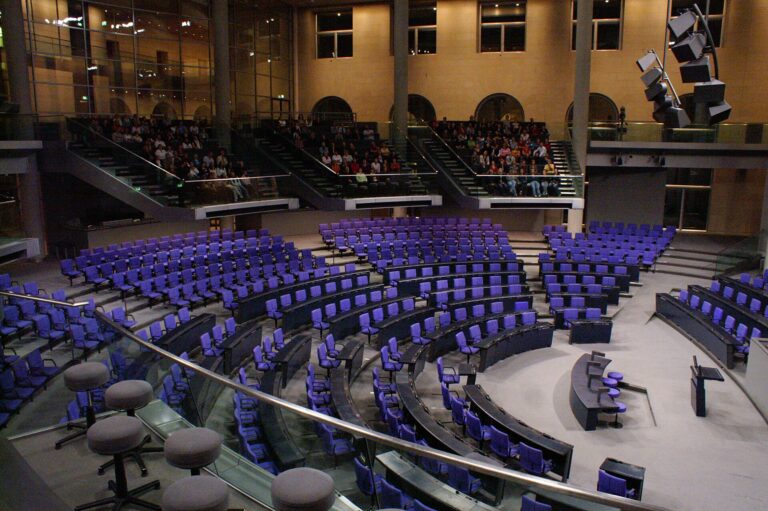
On Friday, 6 November, the Bundestag votes from 9 a.m. on the final version of a law targeting drink spiking with so-called knockout drops. The Legal Affairs Committee approved the government bill (Drucksache 21/7560) on Wednesday with votes from the CDU/CSU, SPD, Greens and Left; the AfD abstained. A majority in the chamber is considered safe (as of 4 November).
A gap opened by a single ruling
The trigger was a Federal Court of Justice (BGH) decision of 8 October 2024 (ref. 5 StR 382/24). A man had dripped drops into a victim’s drink to make her sexually compliant. The court found violence, but not the use of a “dangerous tool” under section 177(8) no. 1 of the Criminal Code: a liquid is not an object, and a wider reading would breach the constitutional requirement that criminal law be precise. The result is that such cases carry a minimum of three years instead of five.
The bill adds “dangerous means” alongside weapons and dangerous tools in section 177(8) no. 1 and section 250(2) no. 1 (aggravated robbery). That covers substances capable, in the specific case, of causing considerable injury or serious damage to health, whether or not the offender applies them directly to the victim. In committee the CDU/CSU and SPD tightened the wording so that it applies to all offences under subsections 1 to 7, including multi-step scenarios. That answers concerns from the Bundesrat, whose own draft (21/551) used different wording and is preferred by the AfD.
A Green amendment failed, as did the party’s motion for a cross-ministry strategy against “spiking”, with prevention, research and confidential evidence collection without a police report.
Is a tougher law enough?
Justice Minister Stefanie Hubig (SPD) called the change a “strong stop sign” at the first reading in September, but added: “We need education, we need better prevention.” Criticism comes from two directions. The German Bar Association (DAV) and the Federal Bar (BRAK) argued, when the cabinet draft appeared, that there is no legal gap: up to 15 years is already possible in the worst cases, and there is no reliable data on how widespread the crime is. The Association of German Judges (Richterbund) considers the higher minimum appropriate, but managing director Sven Rebehn says what deters offenders is “the risk of being caught and convicted”, which is hard to raise with overstretched prosecutors.
That is where the real difficulty lies. There are no reliable nationwide figures, and not every state records knockout-drop offences separately. Hesse reported 94 cases for 2024, the highest in ten years, with a clear-up rate below a quarter. Munich toxicologist Florian Eyer of the Klinikum rechts der Isar says common substances such as GHB are usually detectable for only six to eight hours, twelve at most. Without a quick test, a victim often has no evidence in court.
Our assessment: Friday’s vote should be a formality, with the Bundesrat still to follow, and the law will apply only to offences committed after it takes effect. Whether it brings more convictions will depend less on the sentencing range than on fast, if necessary anonymous, evidence collection and better-trained clinic and police staff. Politics has not yet settled that question.
If you suspect your drink was spiked: go to a hospital as soon as possible and ask for blood and urine tests; if that is not possible at once, you can collect urine yourself in a clean container and keep it cool. Tell several people you trust and report it to the police. The “Violence against Women” helpline (116 016) is open around the clock, is anonymous and advises in 19 languages.
Sources: Bundestag (hib), Bundestag (text archive), ZDFheute, LTO, hessenschau