The European Union agreed in Luxembourg on Monday the largest single expansion of its Russia sanctions lists since the start of the war of aggression against Ukraine. According to the EU and media reports, the new measures cover between 1,569 and 1,646 people and organisations. More than half of the entries are connected with the production chain for ballistic missiles, according to the EU’s foreign policy chief Kaja Kallas. EU foreign ministers approved the package on Monday, 12 October, in Luxembourg, as reported by ZDFheute and the Berliner Zeitung, among others.
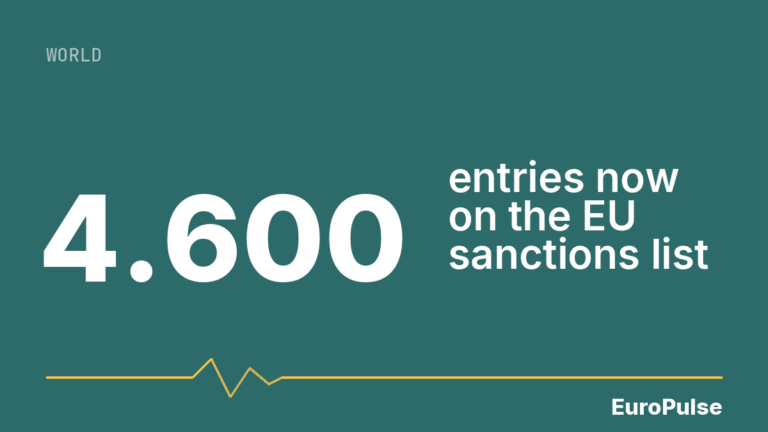
On the platform X, Kallas spoke of the “largest expansion of our sanctions list since the start of the war”. According to her, the measures aim to make it “significantly harder, slower and more expensive” for Russia “to produce the weapons with which it kills Ukrainians”. According to the EU Council, this is the largest sanctions block the Union has ever adopted in one go. The total number of people and organisations listed under EU sanctions against Russia thus stands at almost 4,600.
Missiles, drones, submarine shipyards
According to the EU Council, the list targets mid-tier suppliers that form the “core” of the Russian arms industry. These companies generated annual revenue of at least 20 billion euros and employed more than 250,000 people, the EU Council said, according to Interfax. They supplied key components for modern Russian weapons systems – including electronics with semiconductors, microchips and computers, communications technology with radars, antennas and receivers, aviation, satellite and missile systems, explosives and ammunition, as well as optical and navigation systems.
According to the Kyiv Post and the Berliner Zeitung, the package covers shipyards, aerospace companies, electronics manufacturers and repair facilities for armoured vehicles. The main criterion was whether the businesses receive state subsidies and are officially counted as part of the military-industrial complex. Citing the news agency dpa, the Berliner Zeitung also names drone manufacturers and shipyards that maintain submarines. According to Reuters, which the Berliner Zeitung quotes, manufacturers of special textiles, synthetic fibres and carbon fibres are also on the list.
The sanctions mean the freezing of assets within the Union and a ban on providing those listed, directly or indirectly, with money or other economic resources. For natural persons, an EU entry ban also applies. According to the Kyiv Independent, it is unclear whether the newly affected companies even hold assets in the EU or do business there.
77 election officials and seven North Korean entries
In addition to the arms complex, the ministers agreed punitive measures against several dozen officials responsible for organising elections in occupied areas of Ukraine. ZDFheute and the Kyiv Post name 77 people who are being sanctioned for their involvement in the State Duma elections in the occupied Ukrainian territories. Such elections and their results would “never be recognised”, a statement by the EU foreign policy chief on behalf of the 27 member states already said in September, to which ZDFheute refers.
The EU is also adding seven North Korean organisations and individuals to the list. They are accused of supporting Russia’s war effort. The background is growing concern about military cooperation between Moscow and Pyongyang.
Wadephul: “Unprecedented sanctions strike”
German Foreign Minister Johann Wadephul (CDU) spoke, according to ZDFheute, of an “unprecedented sanctions strike” against the war economy of Kremlin chief Vladimir Putin. “We are making it harder for Putin to continue his invasion war in violation of international law – and his cynical attempt to wear down the Ukrainian civilian population with murderous bombing terror,” Wadephul declared. He did not personally take part in the consultations in Luxembourg because of a CDU leadership retreat in Berlin. “We will increase the pressure until Putin is ready to negotiate seriously about peace in Ukraine,” he added.
In Luxembourg, Kallas said sanctions had already deprived Russia of one trillion euros, money that is now not available to finance the war. The measures against the Russian shadow fleet used to circumvent sanctions were also making it considerably harder for the country to finance the war. According to ZDFheute, the EU’s top diplomat also wants the sanctions to be understood as a signal against the controversial diesel agreement between US President Donald Trump and Putin. At the weekend, Kallas and other senior European politicians criticised the agreement as a “completely wrong signal”. Suspending sanctions on Russian diesel supplies would give Moscow additional revenue to finance its war, Kallas said.
With a view to the sanctions, Green politician Omid Nouripour demanded that Europe further increase pressure on Russia. “The Europeans must raise their own voice,” he said, according to ZDFheute.
The decision comes at a time when the European Commission is placing greater emphasis on enforcing existing measures. In her State of the European Union address in Strasbourg in mid-September, Commission President Ursula von der Leyen called for loopholes to be closed consistently. “The pressure on Russia must be increased further,” she said at the time.
A senior EU official told the Kyiv Independent that the effect of the listings on business with third countries should not be underestimated. Countries in South-East Asia in particular are not prepared to burden their relations with the EU by doing business with sanctioned companies. Circumvention via third countries such as China, Turkey, India and Central Asian countries is regarded as a lasting difficulty.
Editor’s note: The figures on the victims of the latest Russian attacks – according to ZDFheute more than 80 killed Ukrainian civilians within two days – refer to the period before the sanctions decision. According to ZDFheute, the EU foreign ministers also noted that Russia has intensified its hybrid attacks against Europe, both against EU member states and against Nato allies.
Earlier coverage: EU adopts largest sanctions list since war began