France is holding Iran’s Revolutionary Guards responsible for the cyberattacks on refrigeration systems at French supermarkets. Foreign Minister Jean-Noël Barrot said in Paris on Monday that the Iranian ambassador had been summoned “to protest very forcefully against this extremely serious act”. Thanks to the work of the state authorities, he could confirm “that responsibility for this attack lies with the Revolutionary Guards of the Islamic Republic of Iran”, Barrot said, as reported by infranken.de, among others.
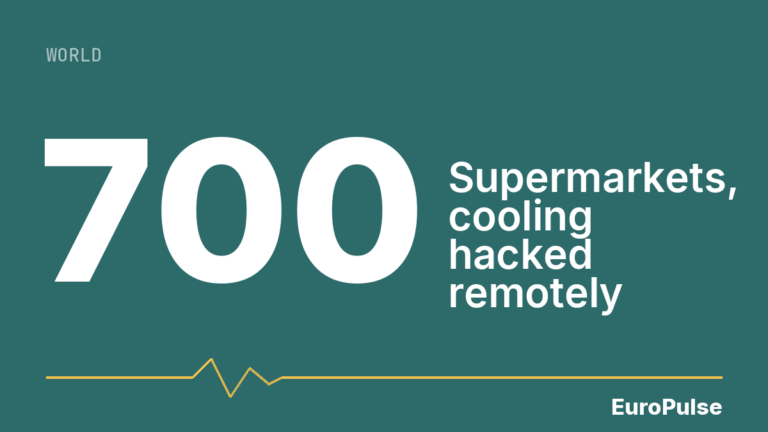
It was “the first large-scale cyberattack for sabotage purposes on French territory”, the minister continued. The attack represented “a serious violation of the interests of the nation and the security of French women and men”. According to Barrot, around 700 supermarkets in France were affected in the night of 11 to 12 October. Large quantities of goods spoiled, and there were also outbreaks of fire. According to fr.de, the perpetrators remotely manipulated the controls of networked refrigeration systems so that refrigerators and freezers heated up instead of cooling.
Sanctions announced at European level
Paris has announced consequences. “We will impose sanctions at European level against all those responsible for this attack and take all other appropriate and necessary measures – whether public or non-public – to respond to this attack and to deter those who might repeat it,” Barrot said. According to fr.de, the French judiciary and the cybercrime department of the public prosecutor’s office are already investigating.
The wave of attacks was not limited to France. Since mid-October, according to infranken.de, other European countries have been hit by cyberattacks on refrigeration and freezing systems in supermarkets and food businesses. fr.de reports, citing those affected, that branches of German retail chains were also affected, including a butcher’s shop in the Upper Palatinate where the refrigeration systems had been set to up to 150 degrees. In early November, the French blood bank also came into the attackers’ sights. According to infranken.de, the EU Commission convened an emergency meeting. According to findings by IT security authorities, the attackers exploited security gaps and standard passwords in control devices accessible via the internet in order to deliberately activate defrost cycles.
Until now, the authorship of the sabotage wave had been unclear; there had previously been suspicions of hybrid attacks from Russia. There was initially no official reaction from the Iranian leadership.
Wadephul warns against new military escalation
The news coincides with the start of the two-day G7 foreign ministers’ meeting in Paris. Before his departure on Monday morning in Berlin, German Foreign Minister Johann Wadephul called for concrete negotiations in the Iran conflict. “Diplomacy is running at full speed,” he said, according to n-tv.de. “For the Iran conflict, that means concrete negotiations now and no new military escalation.”
According to tagesschau.de, the focus of the talks under the French presidency is Russia’s war of aggression against Ukraine and the search for a comprehensive peace solution. The ministers also want to discuss the situation in the Middle East and the security of trade and sea routes. Alongside Germany and France, the G7 includes the United Kingdom, Italy, Japan, Canada and the USA. US Secretary of State Marco Rubio also intends to come to Paris. According to the Federal Foreign Office, a meeting with the foreign ministers of Ukraine, Brazil, Saudi Arabia, Egypt and South Korea is also planned.
Wadephul rejected calls for a new European security architecture as a way to end Russia’s war of aggression. “Europe does not need a new security architecture, as Russia wants us to believe, but simply the restoration of the existing security architecture,” he said, according to tagesschau.de. According to the Federal Foreign Office, the order is to be restored on the basis of the Helsinki Final Act, the Charter of Paris and the Budapest Memorandum.
Abu Dhabi: Europeans to be “well represented”
From Tuesday, according to tagesschau.de, Ukraine and Russia will negotiate in Abu Dhabi, with US mediation, on a possible end to the war that has been running since 2022 – for the first time since February. The Europeans had insisted on participation; according to French officials, Europe is to be “well represented”. A spokesperson for the EU Commission said she could confirm “that the EU will take part in meetings in Abu Dhabi that are part of the ongoing peace efforts, together with other partners”. The Council of member states will also be represented. The Kremlin denied that European representatives would take part. Kremlin spokesman Dmitry Peskov said that, on the European side, Moscow had so far seen no willingness to discuss questions of a future security system; the Europeans had not even appointed a negotiator.
Editor’s note: The assessment that the G7 in Paris is meeting under the impression of two very different crises is an evaluation by this editorial team.