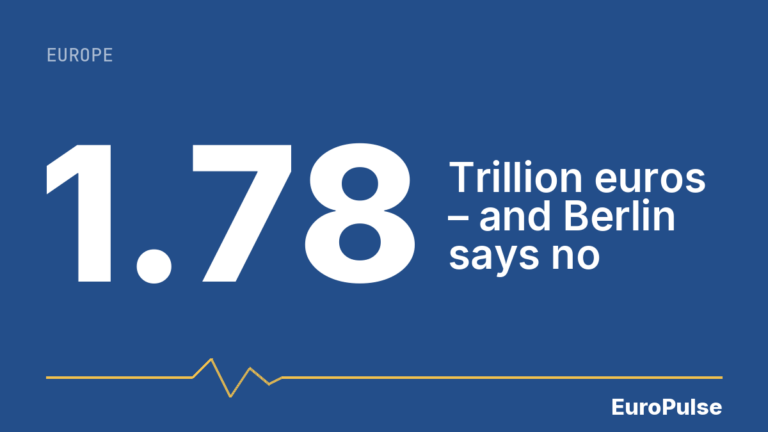
Two days before the EU summit in Brussels, the agenda is clear: the Commission’s proposal for Kyiv’s 2027 financing has been on the table formally since 18 November, no longer just a newspaper leak. Nothing is decided yet. Here is where things stand on 24 November.
What exactly is being proposed?
A new loan of up to €45 billion, the “Instrument for Coordinated Support to Ukraine”. Up to €25 billion would go to military assistance and up to €20 billion into Ukraine’s state budget – the latter only against reforms, including on the rule of law and anti-corruption. According to Eunews, €14.4 billion of it is earmarked for drones and ammunition, with payouts possible from January 2027.
The Commission would borrow the money on capital markets, backed by headroom in the EU budget. Kyiv would repay only if Russia pays reparations. Executive Vice-President Valdis Dombrovskis says interest falls due from 2028, outside the current multiannual budget. A second route of up to €5 billion runs through the Ukraine Facility, backed by guarantees from top-rated third countries.
Why isn’t the €90 billion enough?
Because it was built on an assumption that did not hold: the EU agreed the €90 billion loan in December 2025 expecting the war to end in 2026. Ursula von der Leyen says Kyiv’s needs for this year are covered. For 2027, President Zelensky puts the cost of the war at €155 billion. Kyiv sizes the extra gap at $32.6 billion for the budget and $45 billion for the armed forces – roughly €70 billion – and the Commission adopted that estimate after technical talks.
The €70 billion comes on top of the €45 billion due in 2027 under the existing loan. The new instrument is meant to cover about two-thirds of the gap. Partners such as the UK, Norway, Canada and Japan are asked to cover the rest – roughly €25 billion, though the sources differ slightly on the rounding.
Who is holding it up, and why?
The budget guarantee needs an amendment to the EU’s long-term budget regulation. In our assessment that requires unanimity, which is why the sceptics carry so much weight. Czechia, Slovakia and Hungary are already exempt from the €90 billion loan; in October Robert Fico said at least two countries would stay out of a new mechanism. Berlin, according to the Financial Times and ZDFheute, ties its consent to the 2028–2034 EU budget to a pledge from all 27 states to back Ukraine – see our report of 22 November.
The Commission also keeps a back door open: the Union “reserves its right” to use immobilised Russian assets to repay the loans, and wants windfall profits from them to service EU and G7 loans. The principal stays untouched. Of roughly €210 billion frozen in the EU, about €185 billion sits at Belgium’s Euroclear; Prime Minister Bart De Wever calls using it “confiscation”. The EU ambassador to Ukraine, Katarína Mathernová, said in October she did not expect the issue on the agenda in the short term.
What is realistic on Thursday?
European Council President António Costa will first hold a Euro Summit with ECB President Christine Lagarde, then turn to the budget and Ukraine. “I expect the work to conclude on Friday,” he writes in his invitation letter. On Ukraine he names the Commission’s proposal as the basis, “and beyond”.
Our assessment, with medium confidence: the likeliest outcome is political backing for the principle, with carve-outs for the holdouts and legal texts only in December. It is also quite possible that the row over the seven-year budget holds everything up until the regular summit on 17–18 December. An outright no would be the surprise, because time works against everyone: for money to flow in January, Council and Parliament must deliver within weeks.
For Ukrainians in Germany, residence status and benefits are unaffected. But whether Kyiv can pay salaries, pensions and drone production in 2027 without a hole is decided here – and with it, how much help relatives back home will need from abroad. Earlier coverage: Ukraine-Kredit: Brüssel plant 45 Milliarden mehr.
Sources: European Commission, Euronews, Eunews, Yevropeiska Pravda, Interfax-Ukraine