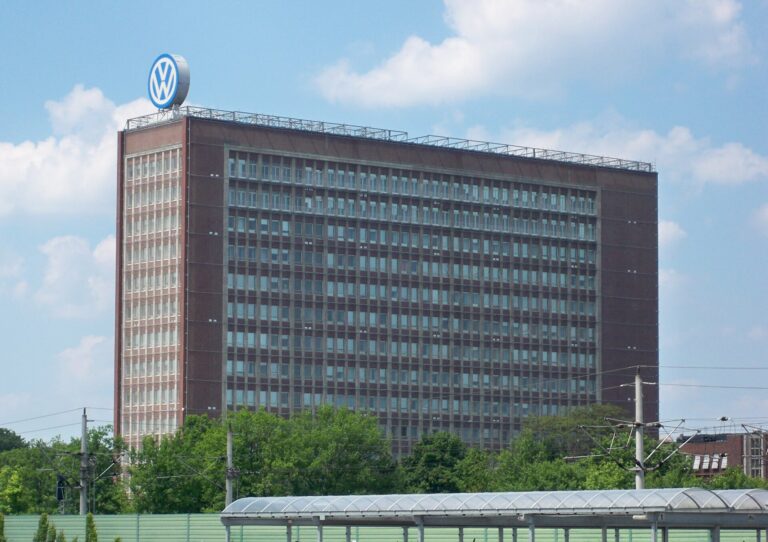
Volkswagen recorded a loss of around €5.82 billion in the third quarter. The group announced this on Thursday, as reported by WELT and the Swiss broadcaster SRF, among others. In the same quarter of the previous year, the carmaker had also reported a shortfall, at that time just over €1.07 billion.
Revenue fell by 6.3 per cent from July to September to around €75.28 billion. According to VW, the decline is mainly due to special effects amounting to €7.8 billion. Added to this are the weak market environment in China, increasing global price and competitive pressure, US tariffs and the higher share of lower-margin electric cars in sales.
A write-down of €6.4 billion on Porsche
The largest single item is a write-down on the goodwill of the sports and SUV subsidiary Porsche amounting to around €6.4 billion. According to VW, the reason is lower expectations for the future development of the Stuttgart-based subsidiary. The impairment is non-cash but significantly weighs on operating profit. Already a year earlier, the situation at Porsche had been one of the main reasons for the quarterly loss. The luxury brand, once a profit engine of the group, has long been in crisis – the slump in the China business, US tariff policy and corrections to the electric strategy have been particularly damaging. Most recently, according to WELT, Porsche’s business figures had stabilised.
There is also a likewise non-cash impairment at the China companies of around €1 billion. According to VW, the planned sale of the Osnabrück plant to the financial investor Aurelius and the state of Lower Saxony also has a negative effect. Both want to align the site towards defence.
First loss-making year since the diesel scandal?
In the first nine months, the group result after tax was minus €2.72 billion – after a surplus of just over €3.4 billion a year earlier. Revenue in this period amounted to around €233.4 billion, 2.2 per cent less than in the previous year. Without the special effects, Volkswagen would have achieved a profit of €8.8 billion in its day-to-day business, and the operating return on sales would have been 3.8 per cent. Overall, the group expects special costs of around €10 billion in the current year; €8.7 billion of this has already been booked. According to WELT’s assessment, Europe’s largest carmaker is therefore heading for its first loss-making year since the diesel scandal.
VW finance chief Arno Antlitz explained according to the statement: “The nine-month result shows clearly: we must not lose any time and must act quickly and decisively.” With the 2030 future plan, the most important measures had been defined – a streamlined model range, simpler structures and improved costs. The board’s plan provides for savings of €31 billion.
Sales also give no signal of easing. From July to September, VW delivered 1.89 million vehicles, almost 14.3 per cent fewer than a year earlier. The group is particularly hard hit in the important market of China: there, the Wolfsburg-based company sold just under 406,000 vehicles in the third quarter, 38.5 per cent fewer. By the end of September, the group’s brands had handed over just over 6 million vehicles to their customers – 9.0 per cent or around 600,000 fewer than in the same period of the previous year.
Even the success in electric cars is currently not helping the balance sheet. “The market success of our electric vehicles puts additional pressure on our result because we still earn less with electric cars today than with combustion engines,” said Antlitz according to the statement. In Europe, in the first nine months, one in five cars was a pure electric vehicle, and incoming orders continue to rise. For the fully electric small-car family around the ID. Polo alone, there were recently 150,000 orders.
A further 50,000 jobs on the line
The cost-cutting programme is hitting employees. At the end of 2024, the group and the employee side had initially agreed to cut more than 35,000 jobs at the core VW brand in Germany by 2030 in a socially acceptable way, as Bild reports. At the beginning of September, the supervisory board then decided on an even larger restructuring: around 50,000 further jobs are to be cut worldwide, including jobs in management. Calculated on this basis, according to WELT, a further 50,000 jobs across the group are on the line; in any case, the loss of 50,000 jobs has already been agreed by the end of the decade. On 30 September, the group employed 614,500 people worldwide; at the end of 2025, the figure was around 628,900. At the core brand, talks with employees begin in November, which are also to address these plans.
For several German sites, there is also as yet no secured competitive follow-on allocation: according to Bild, this affects the VW plants in Emden, Zwickau and Hanover as well as the Audi plant in Neckarsulm for the period from 2031 or in the following years. VW points to massive overcapacity in Europe.
Management around group chief executive Oliver Blume had already significantly lowered expectations for the current year in mid-September: of revenue, at most one per cent should remain as operating profit in 2026; previously the range had been 4.0 to 5.5 per cent. In 2025, the operating margin had been 2.8 per cent. Revenue in 2026 is to reach around €315 billion – the midpoint of the forecast range revised downwards in July. In the previous year, it was €321.9 billion.